
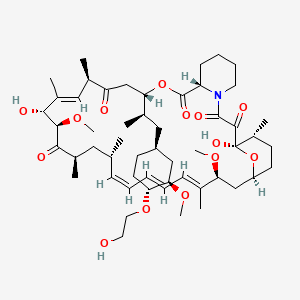
CAS · 159351-69-6
Product Overview
Everolimus is a high-purity a-api supplied for industrial and specialty chemical applications. Contact our team for specifications, packaging options and lead times.
Product Specifications
| Grade | USP43 |
|---|---|
| Appearance | White to faintly yellow powder |
| Assay (on anhydrous and BHT-free basis, contains C53H83NO14) | 98.0% ~ 102.0% |
| Specific Rotation (on anhydrous and BHT-free basis) | -141.0° ~ -153.0° |
| Identification HPLC | The retention time of the major peak in the chromatogram obtained from the test solution should correspond to that obtained from the reference solution, as obtained in the assay |
| IR | Spectrum of the sample should correspond to that of the reference standard |
| Impurity B | 0.5% max. |
| Impurity C | 0.8% max. |
| Impurity D | 0.8% max. |
| Impurity I | 0.8% max. |
| Any individual unspecified impurity | 0.10% max. |
| Total Impurities | 2.5% max. |
| Sirolimus | 0.15% max. |
| Residual Solvents Methanol | 3000ppm max. |
| Methyl formate | 100ppm max. |
| Ethanol | 5000ppm max. |
| Isopropanol | 1000ppm max. |
| Dichloromethane | 600ppm max. |
| Ethyl acetate | 1000ppm max. |
| 1,2-Dimethoxyethane | 100ppm max. |
| Triethylamine | 320ppm max. |
| n-Heptane | 1000ppm max. |
| Toluene | 890ppm max. |
| Ethylene glycol | 620ppm max. |
| Water (KF) | 1.5% max. |
| Residue on ignition | 0.1% max. |
| Microbial limits TAMC | 1000 cfu/g max. |
| TYMC | 100 cfu/g max. |
| E. coli | Should be absent |
Applications
Everolimus (CAS 159351-69-6) is a derivative of rapamycin and functions as a selective inhibitor of the mammalian target of rapamycin (mTOR). It is widely used in the pharmaceutical field as an immunosuppressant to prevent organ transplant rejection and as an antineoplastic agent for the treatment of various cancers, including breast cancer, renal cell carcinoma, pancreatic neuroendocrine tumors, and subependymal giant cell astrocytoma. Additionally, it has applications in cardiology through drug-eluting stents, where it helps reduce restenosis by preventing smooth muscle cell proliferation. In research, everolimus is employed to study cell growth, metabolism, and signaling pathways, making it an important tool in both therapeutic and experimental settings.
Benefits
The benefits of everolimus are closely tied to its dual role in immunosuppression and oncology. By selectively inhibiting mTOR, it regulates cell proliferation, angiogenesis, and survival, providing targeted efficacy against tumor progression while limiting systemic toxicity compared to traditional chemotherapeutics. In transplantation, it offers long-term graft survival with reduced risk of rejection, often in combination with other immunosuppressants. Its incorporation into cardiovascular stents significantly lowers the incidence of restenosis, improving patient outcomes. Beyond clinical benefits, everolimus is also valuable in scientific research, enabling detailed investigation of the mTOR pathway, which is central to many diseases. Its versatility across multiple therapeutic areas underscores its impact on modern medicine.
Conclusion
In summary, everolimus is a highly significant therapeutic compound with applications in oncology, transplantation, cardiology, and biomedical research. Its benefits include targeted inhibition of cell growth pathways, improved patient outcomes in cancer and transplantation, and prevention of vascular complications in stent technologies. As both a clinical drug and a research tool, everolimus continues to play a vital role in advancing treatment strategies and deepening scientific understanding of cellular signaling and disease mechanisms.
Previous
Next