
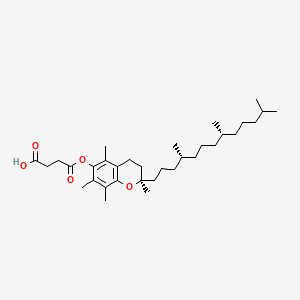
CAS · 4345-03-3
Product Overview
Vitamin E succinate is a high-purity pharmaceutical-intermediates supplied for industrial and specialty chemical applications. Contact our team for specifications, packaging options and lead times.
Product Specifications
| Characteristics | White to almost white particles, odorless |
|---|---|
| Assay | 96.0~102.0% |
| Identification | Conforms |
| Specific optical rotation | +24° min |
| Melting point | 73~78℃ |
| Heavy metals (Pb) | 10 ppm max |
| Lead (Pb) | 3 mg/kg max |
| Arsenic (As) | 3 mg/kg max |
| Cadmium (Cd) | 1 mg/kg max |
| Mercury (Hg) | 0.1 mg/kg max |
| Density / Bulk density | 0.4~0.6 g/m³ |
| Acidity | 18.0~19.3 mL |
| PAHs test (Benzo[a]pyrene) | ≤2 ppb max |
| Total Microbial count | 1000 CFU/g max |
| Moulds and yeasts | 100 CFU/g max |
| Escherichia Coli | ND |
Applications
Vitamin E succinate is widely used in pharmaceuticals, nutraceuticals, cosmetics, and biomedical research. In pharmaceutical and nutraceutical applications, it serves as a stable form of vitamin E, providing antioxidant activity and supporting immune health, cardiovascular function, and cellular protection. It is used in oral supplements, fortified foods, and functional beverages to deliver tocopherol in a more bioavailable and shelf-stable form. In cosmetic formulations, it is incorporated into skin care products, creams, and lotions to protect the skin from oxidative stress, improve moisture retention, and enhance anti-aging effects. In research and biomedical studies, vitamin E succinate is employed as a model antioxidant in studies on oxidative damage, apoptosis, and chemoprevention, and it has been investigated for potential anti-cancer, anti-inflammatory, and neuroprotective effects.
Benefits
Vitamin E succinate offers several advantages over free tocopherols due to its esterified structure. It provides enhanced stability against oxidation, improving shelf life and efficacy in both formulations and supplements. Its antioxidant properties help neutralize free radicals, protecting cellular components and biomolecules from oxidative stress. The succinate ester also facilitates controlled release and improved bioavailability, allowing more efficient delivery of vitamin E in the body. In cosmetic and topical applications, it supports skin barrier function, reduces signs of aging, and mitigates environmental damage. Additionally, its versatility and compatibility with various formulation types make it easy to incorporate into pharmaceuticals, nutraceuticals, and personal care products.
Conclusion
Vitamin E succinate is a stable, bioavailable form of vitamin E with broad applications in nutrition, pharmaceuticals, cosmetics, and biomedical research. Its antioxidant properties, enhanced stability, and formulation versatility make it a valuable ingredient for protecting health, supporting skin care, and enabling scientific studies on oxidative stress and disease prevention. These qualities ensure its continued use across multiple industries and research applications.
Previous
(S)-3-Amino-3-(4-chlorophenyl)propan-1-ol丨CAS 886061-26-3
Next