
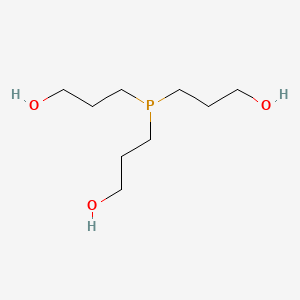
CAS · 4706-17-6
Product Overview
Tris(3-hydroxypropyl)phosphine is a high-purity ligands supplied for industrial and specialty chemical applications. Contact our team for specifications, packaging options and lead times.
Product Specifications
| Purity (T) | 80% min |
|---|---|
| Appearance | Colorless very dark yellow viscous |
| IR | Confirm the structure |
Applications
Tris(3-hydroxypropyl)phosphine is a versatile organophosphorus compound used primarily in chemical synthesis, materials science, and catalysis. It serves as a reducing agent in the preparation of disulfides and as a ligand in transition-metal catalyzed reactions, such as hydrogenation and cross-coupling processes. The presence of hydroxyl groups enhances solubility in polar solvents, making it suitable for aqueous or mixed-solvent reaction systems. In polymer and materials chemistry, it is employed as a stabilizer or functional modifier for epoxy resins, polyurethane systems, and other polymeric materials. It is also used in fine chemical synthesis for creating phosphine-containing intermediates and in organic transformations requiring mild reducing conditions.
Benefits
The benefits of tris(3-hydroxypropyl)phosphine include its high nucleophilicity, solubility, and low toxicity relative to other phosphines. The hydroxyl-functionalized propyl groups improve handling safety and compatibility with polar solvents, enhancing reaction efficiency and selectivity. Its reducing properties allow for mild and controlled reduction reactions, minimizing by-products and degradation of sensitive molecules. Additionally, its multifunctional hydroxyl groups provide opportunities for further derivatization, cross-linking, or incorporation into polymers, expanding its utility in materials science and chemical synthesis.
Conclusion
Tris(3-hydroxypropyl)phosphine is a versatile organophosphorus reagent valuable in reduction chemistry, catalysis, and polymer modification. Its combination of reducing power, solubility, and functional hydroxyl groups enables efficient, selective, and adaptable applications in organic synthesis, material science, and industrial processes. By providing safe and flexible reactivity, it remains an important tool for chemists in both research and industrial settings.
Previous
1,3-Di(1-adaMantyl)iMidazoliniuM Tetrafluoroborate丨CAS 1176202-63-3
Next
1,3-Di-tert-butylimidazolium Tetrafluoroborate丨CAS 263163-17-3