
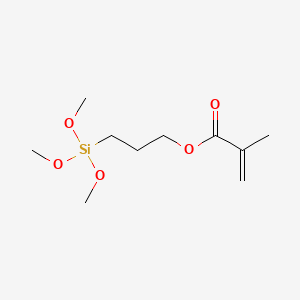
CAS · 2530-85-0
Product Overview
Trimethoxysilylpropyl methacrylate is a high-purity catalysts-auxiliary-agent supplied for industrial and specialty chemical applications. Contact our team for specifications, packaging options and lead times.
Product Specifications
| Property | Specification |
|---|---|
| Appearance | Colorless transparent liquid |
| Purity (GC) | 98% min |
| Color (Pt-Co) | 25 max |
| Specific Gravity | 1.039–1.050 (20°C) |
| Refractive Index | 1.428–1.430 (25°C) |
| Water dispersion | Qualified |
Applications
1. Surface Modification and Adhesion Promotion
Trimethoxysilylpropyl methacrylate丨CAS 2530-85-0 is widely used to modify the surface of inorganic materials to improve adhesion with organic polymers.
● Glass fiber treatment: Used to coat glass fibers in reinforced composites, enhancing the bond between the fiber and polymer matrix (e.g., polyester, epoxy, or acrylic resins).
● Metal and ceramic primers: Applied to aluminum, titanium, and ceramic surfaces to improve coating, painting, or adhesive bonding performance.
● Filler coupling: Silica, alumina, and other fillers can be surface-treated with TMSPMA to improve dispersion in polymer matrices and increase mechanical strength.
2. Adhesives and Sealants
TMSPMA is incorporated into formulations of adhesives and sealants to enhance cohesion and substrate adhesion, particularly in moist or variable environments.
● Silicone sealants: Enhances crosslinking and durability when exposed to atmospheric moisture.
● Reactive adhesives: Participates in the curing process through both methacrylate polymerization and silanol condensation.
3. Polymer and Resin Modification
It serves as a functional monomer or crosslinking agent in acrylic, urethane, epoxy, and vinyl polymer systems.
● Copolymerization: The methacrylate group can be copolymerized with other vinyl monomers to impart silane functionality into the polymer backbone.
● Improved mechanical properties: Helps form interpenetrating networks that increase toughness, moisture resistance, and dimensional stability.
4. Dental and Biomedical Applications
Due to its strong binding to both inorganic fillers and organic resins, TMSPMA is often used in dental composites and adhesives.
● Dental bonding agents: Promotes strong bonding between silanized glass fillers and methacrylate-based dental resins.
● Biomedical coatings: Used in surface-modification of implants to improve cell adhesion or functionalization for tissue engineering.
5. Coatings and Paints
TMSPMA is employed in paint and coating formulations to enhance substrate adhesion, moisture resistance, and weatherability.
● Anticorrosive coatings: Helps paints adhere to metal surfaces and protects against moisture intrusion and oxidation.
● Self-cleaning and protective coatings: Contributes to the durability and functionalization of coatings for architectural glass, automotive parts, and building materials.
6. Electronics and Optoelectronics
TMSPMA is used in microelectronics and optoelectronic devices for modifying surfaces and encapsulants.
● Improved dielectric properties: Enhances interfacial adhesion in multilayer electronics and dielectric resins.
● Surface treatment of substrates: Helps functionalize glass or silicon wafers for improved compatibility with polymer layers or protective coatings.
Benefits
1. Excellent Adhesion Promotion
The silane end of Trimethoxysilylpropyl methacrylate丨CAS 2530-85-0 can undergo hydrolysis and condensation with hydroxyl-containing surfaces (e.g., SiO₂, Al₂O₃), while the methacrylate end can copolymerize with acrylic or vinyl resins.
● Dual reactivity: Enables strong, covalent bonding between inorganic and organic phases.
● Improved adhesion: Enhances mechanical properties and environmental resistance of composite materials and adhesives.
2. Versatility Across Industries
TMSPMA finds utility in automotive, construction, electronics, biomedical, and textile industries due to its broad compatibility with substrates and resins.
● Universal coupling agent: Compatible with a wide variety of resins, including epoxy, polyester, acrylic, and polyurethane.
● Multi-functional material: Offers performance enhancement in coatings, composites, adhesives, and surface treatments.
3. Improved Durability and Environmental Resistance
By enhancing crosslinking and adhesion at interfaces, TMSPMA contributes to the durability and longevity of materials.
● Water resistance: Reduces delamination and degradation caused by moisture ingress.
● Weatherability: Improves performance of outdoor coatings and materials exposed to UV, heat, and environmental stress.
4. Enhanced Composite Performance
In fiber-reinforced plastics and composites, TMSPMA improves the interfacial strength between fillers or reinforcements and the polymer matrix.
● Higher tensile and flexural strength
● Better impact resistance and dimensional stability
● Reduced filler sedimentation during processing
Conclusion
Trimethoxysilylpropyl methacrylate丨CAS 2530-85-0 is a highly effective silane coupling agent and functional monomer that significantly enhances the interface between organic polymers and inorganic materials. Its dual-reactive nature makes it indispensable in composite materials, adhesives, coatings, and biomedical applications. With benefits such as improved adhesion, increased durability, and greater mechanical performance, TMSPMA plays a crucial role in enabling advanced materials and high-performance products across diverse industries.
Previous
N,N-Methylenebisacrylamide丨CAS 110-26-9
Next
Conclusion
A concise summary and suitability assessment for this product is available on request. Contact our team to discuss whether it fits your process and quality requirements.