
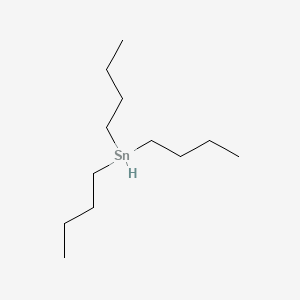
CAS · 688-73-3
Product Overview
Tributyltin is a high-purity catalysts-auxiliary-agent supplied for industrial and specialty chemical applications. Contact our team for specifications, packaging options and lead times.
Product Specifications
| Appearance | Colorless or light yellow liquid |
|---|---|
| Purity (GC) | 98% min |
Applications
Tributyltin (TBT) is an organotin compound historically used in a variety of industrial, agricultural, and marine applications. Its primary use has been as a biocide and antifouling agent in marine paints to prevent the growth of barnacles, algae, and other aquatic organisms on ship hulls, underwater structures, and fishing equipment. Tributyltin has also been employed in agriculture as a fungicide, wood preservative, and molluscicide to protect crops, timber, and plants from pests and microbial damage. In chemical synthesis, TBT serves as a reagent for organic transformations, such as stannylation, coupling reactions, and as a catalyst in certain polymerization processes. Its lipophilic and reactive nature has made it useful in specialty chemical research, including organometallic and materials science studies.
Benefits
The benefits of tributyltin historically arose from its strong biocidal activity, chemical reactivity, and versatility. It is highly effective at very low concentrations against a wide range of fungi, algae, mollusks, and bacteria, providing efficient protection in antifouling and agricultural applications. Its chemical stability allows it to remain active over extended periods in coatings or formulations. In organic synthesis, tributyltin compounds offer unique reactivity for introducing tin-based functional groups, enabling selective transformations and facilitating complex molecule construction. Its solubility in organic solvents and lipophilicity improve compatibility with coatings, polymers, and reaction media, supporting practical industrial and laboratory use.
Conclusion
In summary, tributyltin is an organotin compound with applications in antifouling coatings, agriculture, wood preservation, and chemical synthesis. Its benefits-including potent biocidal activity, chemical stability, and synthetic versatility-have historically made it valuable in industrial, agricultural, and research settings. However, due to environmental and health concerns, its use has been restricted or banned in many applications, prompting the development of safer alternatives. Tributyltin remains important in chemical research as a reagent and catalyst, contributing to organometallic chemistry and specialized synthetic processes.
Previous
Aluminum Nitride丨CAS 24304-00-5
Next