
CAS · 87749-50-6
Product Overview
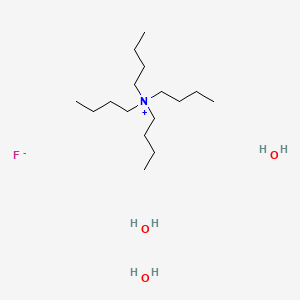
Tetrabutylammonium fluoride trihydrate丨87749-50-6 is a quaternary ammonium salt consisting of a tetrabutylammonium cation (C16H35N⁺) paired with a fluoride anion (F⁻), and the compound also contains three water molecules of crystallization. Its chemical formula is (C16H35NF)·3H2O. This compound is typically used in chemical synthesis, particularly in reactions requiring fluoride ions or in applications where phase transfer catalysis is involved.
Product Specifications
| Property | Value |
|---|---|
| Appearance | White or yellow ceraceous |
| Assay (on anhydrous basis) | 98% min |
| Water | 18% max |
Applications
Fluoride Source in Organic Synthesis
Fluoride Donor: Tetrabutylammonium fluoride trihydrate丨87749-50-6 is commonly used as a source of fluoride ions in organic synthesis. The fluoride anion is a strong nucleophile, and it can participate in nucleophilic substitution reactions (such as SN1 and SN2 reactions) where the fluoride displaces a leaving group (e.g., alkyl halides).
Desilylation Reactions: It is often used in desilylation reactions, where a silicon-based protecting group (such as a trimethylsilyl group) is removed from a molecule, typically a carbohydrate or nucleoside. Tetrabutylammonium fluoride facilitates the removal of these groups by reacting with the silicon and replacing the silyl group with a hydroxyl group.
Nucleophilic Fluorination: The compound can be employed in nucleophilic fluorination reactions, where a fluorine atom is incorporated into an organic molecule. This is particularly useful in synthesizing fluorinated organic compounds, which are important in pharmaceuticals, agrochemicals, and specialty materials.
Phase Transfer Catalysis
Phase Transfer Catalyst (PTC): As a quaternary ammonium salt, Tetrabutylammonium fluoride trihydrate丨87749-50-6e can act as a phase transfer catalyst, facilitating the transfer of fluoride ions between two immiscible phases (e.g., between an aqueous and an organic phase). In PTC reactions, the tetrabutylammonium cation helps dissolve the fluoride anion in the organic phase, making it more accessible to react with organic substrates in that phase.
Cross-Coupling Reactions: Tetrabutylammonium fluoride can also be used to catalyze certain cross-coupling reactions, such as those involved in the synthesis of carbon-fluorine bonds, which are important in the development of fluorinated pharmaceuticals and agrochemicals.
Synthesis of Fluorinated Pharmaceuticals
Fluorine Substitution: Fluorine is a highly valuable element in medicinal chemistry, and tetrabutylammonium fluoride trihydrate can be used in the synthesis of fluorinated pharmaceuticals. Fluorine atoms in drugs can increase metabolic stability, improve bioavailability, and enhance the activity of the drug. The fluoride source can be used in the synthesis of fluorinated organic molecules for drug discovery.
Fluorine Incorporation into Heterocycles: Tetrabutylammonium fluoride is often used for the selective incorporation of fluorine atoms into heterocyclic compounds, which are frequently found in drugs targeting a wide range of diseases.
Fluoride-Mediated Reactions
Fluorination of Aromatic Compounds: The compound can be used in the selective fluorination of aromatic compounds, such as aryl halides. This is useful in the production of various fluorinated aromatic compounds, which are valuable as intermediates in the chemical and pharmaceutical industries.
Synthesis of Fluorinated Polymers: Tetrabutylammonium fluoride can also be used in the production of fluorinated polymers by introducing fluorine atoms into polymer backbones or side chains. Fluoropolymers are widely used in coatings, lubricants, and electronics due to their chemical resistance and thermal stability.
Solvent and Reagent in Analytical Chemistry
Analysis of Fluorinated Compounds: In analytical chemistry, Tetrabutylammonium fluoride trihydrate丨87749-50-6 can serve as a reagent for the analysis of fluorinated compounds. It can help identify the presence of fluorine atoms in a sample or be used in the preparation of calibration standards for mass spectrometry or nuclear magnetic resonance (NMR) spectroscopy.
Ion-Pairing Reagent: It can be used as an ion-pairing reagent in chromatography, particularly in ion chromatography, to enhance the retention and separation of certain anions.
Benefits
The key benefits and differentiators of this product are available on request. Contact us for performance data, comparative specifications and selection guidance.
Conclusion
Tetrabutylammonium fluoride trihydrate丨87749-50-6 is a versatile and useful reagent in organic synthesis, acting as a fluoride donor in various chemical reactions, particularly in nucleophilic substitution and fluorination reactions. Its role as a phase transfer catalyst and its applications in the synthesis of fluorinated organic molecules, including pharmaceuticals and agrochemicals, make it an important compound in both academic and industrial chemistry. However, it should be handled with caution due to the toxicity of fluoride ions and the need for proper safety protocols during storage, handling, and disposal
Previous
Next