
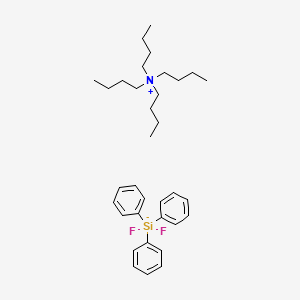
CAS · 163931-61-1
Product Overview
Tetrabutylammonium difluorotriphenylsilicate is a high-purity silicon-compounds supplied for industrial and specialty chemical applications. Contact our team for specifications, packaging options and lead times.
Product Specifications
| Appearance: | white crystal solid |
|---|---|
| Purity(by GC): | 95% min |
Applications
1. Fluoride Source in Organic Synthesis
The compound serves as a mild and stable source of fluoride ions for desilylation reactions, deprotection of silyl ethers, and activation of silicon-based reagents.
It offers better solubility and handling compared to inorganic fluoride salts like KF or CsF.
Used in fluoride-mediated cleavage of trialkylsilyl or triaryl silyl protecting groups in the synthesis of complex molecules, including pharmaceuticals and natural products.
2. Catalyst or Reagent in Silicon-Based Chemistry
It is employed in organosilicon chemistry as a reagent to generate reactive silicon intermediates.
Used in the synthesis of fluorosilanes, silicon-containing polymers, and silicon-based materials with tailored properties.
Acts as a nucleophilic fluorine donor in silicon–fluorine bond-forming reactions.
3. Mild Fluoride Delivery Agent
Compared to harsher fluoride sources like HF or TBAF (tetrabutylammonium fluoride), tetrabutylammonium difluorotriphenylsilicate provides a controlled fluoride release, minimizing side reactions.
Useful in sensitive synthetic steps requiring fluoride ions without excess nucleophilicity or basicity.
4. Facilitates Fluoride-Induced Activation
Activates silicon reagents in cross-coupling, addition, or substitution reactions.
Enhances reactivity of silicon nucleophiles by forming reactive pentacoordinate silicon species.
5. Material Science and Surface Chemistry
Used in the functionalization of silicon surfaces, enabling fluoride-mediated etching or surface modification.
Plays a role in preparing fluorosilane-based coatings with hydrophobic or oleophobic properties.
Benefits
1. Stability and Ease of Handling
Unlike aqueous or gaseous fluoride sources, this salt is stable, non-volatile, and easier to weigh and store.
It can be handled under normal laboratory conditions with less hazard.
2. Selective and Controlled Fluoride Release
The difluorotriphenylsilicate anion allows for controlled delivery of fluoride ions, reducing side reactions in sensitive molecules.
Facilitates mild desilylation and other fluoride-dependent transformations without damaging sensitive functional groups.
3. Enhanced Solubility in Organic Media
The tetrabutylammonium cation increases solubility in organic solvents such as THF, DMF, or DCM.
This enhances its use in homogeneous organic synthesis, increasing reaction efficiency and reproducibility.
4. Versatility
Suitable for a broad range of synthetic applications, including pharmaceuticals, agrochemicals, and specialty chemicals.
Compatible with multiple reaction types, including nucleophilic substitutions, eliminations, and additions involving silicon-fluoride chemistry.
5. Reduced Toxicity Compared to HF-Based Reagents
Offers a safer alternative to highly corrosive hydrofluoric acid (HF) or its derivatives.
Allows synthetic chemists to perform fluoride chemistry with reduced exposure risks.
Conclusion
Tetrabutylammonium difluorotriphenylsilicate (CAS 163931-61-1) is a valuable fluoride ion source in modern synthetic and materials chemistry. Its unique combination of:
Controlled fluoride release
Stability and ease of handling
Solubility in organic solvents
Versatility in silicon-based and organic reactions
makes it indispensable for selective desilylation, activation of silicon reagents, and surface functionalization. It bridges the gap between highly reactive fluoride sources and the need for mild, selective synthetic methods, especially in the pharmaceutical and fine chemical industries.
Previous
Chloromethyltrimethylsilane丨CAS 2344-80-1
Next