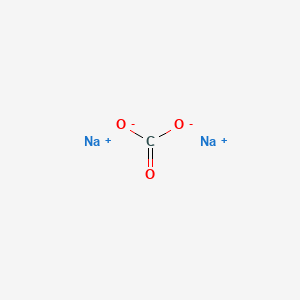
CAS · 497-19-8
Product Overview
Sodium carbonate is a high-purity a-api supplied for industrial and specialty chemical applications. Contact our team for specifications, packaging options and lead times.
Product Specifications
| Appearance | White/almost white slightly granular hygroscopic powder |
|---|---|
| Solubility | Freely soluble in water, practically insoluble in ethanol (96%) |
| Assay (dried substance) | 99.5% ~ 100.5% |
| Identification | A. pH of 10% solution: The solution is strongly alkaline B. Chemical reaction: gives the reaction of Carbonates C. Chemical reaction: gives the reaction (a) of Sodium D. Loss on drying |
| Appearance of solution | The solution is clear and not more intensely coloured than reference solution Y6 |
| Alkali hydroxides/bicarbonates | The solution remains clear |
| Chlorides | 125 ppm max |
| Sulfates | 250 ppm max |
| Arsenic | 5 ppm max |
| Iron | 50 ppm max |
| Loss on drying | 1.0% max |
| Microbial limits | TAMC: 1000 cfu/g max TYMC: 100 cfu/g max E. coli: Absent |
| Particle size | 100% pass 100 mesh |
Applications
Sodium carbonate, commonly known as soda ash, is a versatile inorganic compound with broad applications in industrial, household, and laboratory settings. In industry, it is used in glass manufacturing, water softening, detergents, and paper production. It serves as a pH regulator, buffering agent, and reactant in chemical synthesis, including the production of sodium bicarbonate, silicates, and carbonates. In laboratories, sodium carbonate is employed as a standard reagent, buffering agent, and drying agent in various analytical and synthetic processes. It is also used in food processing as an acidity regulator and leavening agent.
Benefits
The benefits of sodium carbonate include its strong alkalinity, high solubility, and cost-effectiveness. It efficiently neutralizes acids, softens water, and improves the cleaning performance of detergents. Its stability and low toxicity make it safe for use in food, industrial, and laboratory applications. Sodium carbonate also enhances chemical reaction efficiency, provides consistent pH control, and supports environmentally friendly processes due to its non-hazardous nature. Its multifunctional properties make it indispensable across diverse sectors.
Conclusion
Sodium carbonate is a key inorganic compound with extensive applications in industry, laboratory work, and food processing. Its alkalinity, solubility, and versatility provide practical solutions for pH control, cleaning, and chemical synthesis. By supporting efficient, safe, and cost-effective operations, sodium carbonate continues to play a critical role in multiple fields and everyday applications.
Previous
Cetirizine Hydrochloride丨CAS 83881-52-1
Next