
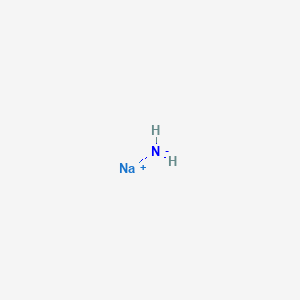
CAS · 7782-92-5
Product Overview
Sodium amide is a high-purity resins supplied for industrial and specialty chemical applications. Contact our team for specifications, packaging options and lead times.
Product Specifications
| Appearance: | Off-white flake or powder |
|---|---|
| Assay: | 98% min |
| Heavy metals: | 20 ppm max |
Applications
1. Strong Base in Organic Synthesis
Commonly used for deprotonation of weakly acidic compounds (e.g., terminal alkynes, ketones, nitriles).
Facilitates enolate formation in aldol condensations and Claisen condensations.
2. Nucleophilic Reagent
Involved in nucleophilic substitution reactions, particularly with aryl halides (e.g., in Chichibabin reactions to form aminated heterocycles).
3. Synthesis of Alkynes
Used to generate acetylide anions from terminal alkynes, which are key intermediates in various organic syntheses including Sonogashira couplings.
4. Heterocyclic Chemistry
Helps form heterocyclic rings (e.g., pyrroles, imidazoles) via base-catalyzed cyclizations or eliminations.
5. Industrial Applications
Applied in the production of dyes, polymers, and pharmaceutical intermediates.
Occasionally used as a desiccant for amines or as a reducing agent in specialized processes.
Benefits
✅ Extremely Strong Base
One of the strongest non-nucleophilic bases available, ideal for tough deprotonation reactions.
✅ Selective Reactivity
Enables selective transformations, especially in sensitive or multifunctionalized molecules.
✅ Versatility
Supports a broad range of organic reactions, from eliminations to ring closures.
✅ Enabling Reagent
Makes otherwise difficult transformations possible, especially under anhydrous conditions.
Conclusion
Sodium amide (NaNH₂, CAS 7782-92-5) is a highly valuable reagent in organic and industrial chemistry, known for its strong basicity and nucleophilic potential. Despite its hazardous nature, it plays a critical role in various chemical transformations, particularly in the synthesis of alkynes, heterocycles, and advanced intermediates. Strict handling precautions are essential for its safe and effective use.
Previous
Bis(trimethoxysilylpropyl)amine丨CAS 82985-35-1
Next