
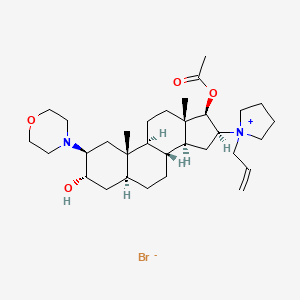
CAS · 119302-91-9
Product Overview
Rocuronium bromide is a high-purity a-api supplied for industrial and specialty chemical applications. Contact our team for specifications, packaging options and lead times.
Product Specifications
| Grade | EP10 |
|---|---|
| Description | White or almost white crystals or crystalline powder |
| Solubility | Freely soluble in water and in anhydrous ethanol |
| Identification - HPLC | The same as standard sample |
| Identification - IR | The infrared absorption spectrum of a mineral oil dispersion of previously dried sample exhibits maxima at the same wavelengths as that of a similar preparation of USP Rocuronium Bromides RS |
| Identification - Bromides reaction | A yellowish white precipitate is formed with silver nitrate test solution |
| Appearance of solution | Conforms |
| Specific optical rotation | +28.5~+32° |
| pH | 8.9 to 9.5 for solution S |
| Impurity A | 0.20% max |
| Impurity B | 0.20% max |
| Impurity C | 0.20% max |
| Impurity D | 0.10% max |
| Impurity E | 0.10% max |
| Impurity F | 0.10% max |
| Impurity G | 0.10% max |
| Impurity H | 0.10% max |
| Total impurities | 1.0% max |
| Any other impurity | 0.1% max |
| Methylene chloride (Residual solvent) | 0.06% max |
| Acetone (Residual solvent) | 0.50% max |
| Acetonitrile (Residual solvent) | 0.041% max |
| MBTE (Residual solvent) | 0.50% max |
| Ethyl Acetate (Residual solvent) | 0.50% max |
| DIETHYL ETHER | Not specified |
| Water content (KF) | 4.0% max |
| Sulphated ash | 0.1% max |
| Heavy metals | 20 ppm max |
| Endotoxin | 0.9 EU/mg max |
| Total aerobic bacteria | 100 UFC/g max |
| Yeast and Mold No. | 10 UFC/g max |
| E. coli | Not Detected |
| Staphylococcus aureus | Not Detected |
| Pseudomonas aeruginosa | Not Detected |
| Salmonella | Not Detected |
| Enterobacteriaceae | Not Detected |
| Assay (HPLC) | 99.0%~101% |
| Bromally content (HPLC) | 0.001% max |
| Chlorides (LC) | 0.1% max |
Applications
Rocuronium bromide (CAS 119302‑91‑9) is used as a neuromuscular blocker in clinical anesthesia. Specifically, it serves to induce skeletal muscle relaxation to facilitate endotracheal intubation and to maintain muscle paralysis during surgeries or mechanical ventilation. It is widely used in general anesthesia for operations, in rapid-sequence induction when quick onset of muscle relaxation is required, and in intensive care settings when ventilatory support necessitates muscle relaxation. Its non-depolarizing mechanism makes it a standard choice for providing stable and controllable neuromuscular blockade during procedures.
Benefits
Rocuronium bromide offers several advantages as an anesthetic adjunct. It has a rapid onset of action - typically allowing intubation within about one minute of intravenous administration - which is especially valuable in emergency or rapid‑sequence induction scenarios. Its duration of action is intermediate, giving sufficient time for surgical procedures without needing extremely frequent re‑dosing. Because it is non‑depolarizing, it avoids the muscle fasciculations and other side effects associated with depolarizing agents, and its effects can be reversed with suitable antagonists, allowing recovery of muscle function once the procedure is over. Additionally, rocuronium tends to cause minimal cardiovascular or autonomic disturbances and does not significantly increase histamine release, making it generally well tolerated.
Conclusion
Rocuronium bromide (CAS 119302‑91‑9) plays a critical role in modern anesthesia by providing rapid, effective, and controllable muscle relaxation for intubation and surgical procedures. Its favorable onset, duration, and safety profile make it a practical and commonly used neuromuscular blocking agent in a variety of clinical settings. When used properly - with adequate anesthesia, monitoring, and reversal when needed - it supports patient safety and smooth surgical or ventilatory management.
Previous
Next