
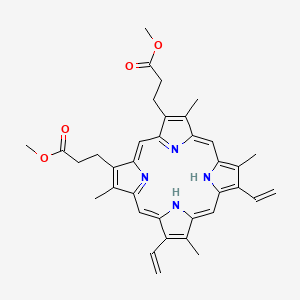
CAS · 5522-66-7
Product Overview
Protoporphyrin IX dimethyl ester丨CAS 5522-66-7 is a chemically modified derivative of protoporphyrin IX, a natural tetrapyrrole compound that serves as the immediate precursor to heme, chlorophyll, and other important biological pigments. The dimethyl esterification of the two carboxyl groups increases its lipophilicity and stability, making it valuable for biochemical studies and applications in photodynamic therapy (PDT) and catalysis.
Product Specifications
| Appearance | Purple powder |
|---|---|
| Purity | 98% min |
| Melting Point | 225 - 228 °C |
| Solubility | Insoluble in water, methanol; very slightly soluble in chloroform; soluble in DMF and DMSO |
| Residual Solvents | Dichloromethane: 30 ppm max |
Applications
1. Biochemical Research
Used as a model compound to study the structure, function, and reactivity of porphyrins and heme-containing proteins.
Helps investigate heme biosynthesis pathways and the role of protoporphyrin IX in cellular metabolism.
Serves as a probe in spectroscopic studies (UV-Vis, fluorescence) due to its distinct photophysical properties.
2. Photodynamic Therapy (PDT)
Protoporphyrin IX and its derivatives are potent photosensitizers; the dimethyl ester is explored for its enhanced cellular uptake and photostability.
Upon light activation, it generates reactive oxygen species (ROS) capable of killing cancer cells or pathogens.
Used experimentally in treatment of cancer, skin diseases, and infectious conditions.
3. Catalysis and Material Science
Acts as a catalyst or catalyst precursor in oxidation reactions and synthetic organic chemistry, mimicking the behavior of natural heme enzymes (e.g., cytochrome P450).
Incorporated into functional materials, such as sensors and molecular electronics, because of its redox activity and strong light absorption.
4. Drug Development
Used in the design and testing of heme analogs and inhibitors targeting heme-dependent enzymes.
Facilitates screening of compounds that affect heme metabolism, relevant for diseases like porphyrias and malaria.
Benefits
1. Enhanced Lipophilicity and Stability
The methyl ester groups increase solubility in organic solvents and membrane permeability, improving bioavailability in cellular studies.
More chemically stable than free protoporphyrin IX, facilitating handling and storage.
2. Strong Photophysical Properties
Absorbs strongly in the visible region (Soret and Q-bands), making it useful in spectroscopic and photodynamic applications.
Efficient generation of singlet oxygen and other ROS upon illumination.
3. Versatile Biochemical Tool
Mimics natural heme while allowing modification and functionalization for detailed mechanistic studies.
Useful for probing enzyme interactions and pathways involving porphyrins.
4. Catalytic Efficiency
Catalyzes oxidation reactions under mild conditions, offering greener alternatives to harsh chemical oxidants.
Provides a platform to develop synthetic catalysts inspired by nature.
Conclusion
Protoporphyrin IX dimethyl ester丨CAS 5522-66-7 is an important porphyrin derivative with applications spanning biochemical research, photodynamic therapy, catalysis, and drug development. Its increased lipophilicity and stability compared to protoporphyrin IX enable enhanced experimental versatility. This compound serves as a vital tool for understanding heme biochemistry, developing new therapeutic modalities, and designing biomimetic catalysts.
Previous
(R)-(-)-Epichlorohydrin丨CAS 51594-55-9
Next