
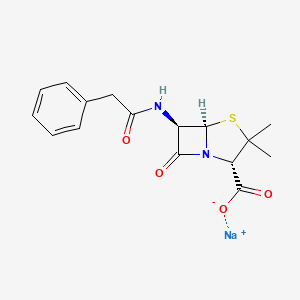
CAS · 69-57-8
Product Overview
Penicillin G sodium salt is a high-purity a-api supplied for industrial and specialty chemical applications. Contact our team for specifications, packaging options and lead times.
Product Specifications
| Grade | EP11.0 |
|---|---|
| Appearance | White or almost white, hygroscopic, crystalline powder |
| Content | 95.0% ~ 102.0% (dried substance) |
| Solubility | Very soluble in water, slightly soluble in ethanol (96%), practically insoluble in methylene chloride |
| Identification | A. Infrared absorption spectrophotometry (compared with benzylpenicillin sodium CRS) D. It gives reaction (a) of sodium |
| pH | 5.5–7.5 |
| Appearance of solution | The solution is clear |
| Related substances | Impurity E (sum of the isomers): 2.0% max Impurity F (sum of the 2 epimers): 1.0% max Impurity B: 0.5% max Impurities A, G, H: 0.2% max Impurities C, D: 0.2% max Any other impurity: 0.2% max Total impurities: 3.0% max |
| 2-Ethylhexanoic acid | 0.5% (m/m) max |
| Loss on drying | 1.0% max |
| Bacterial endotoxins | 0.16 IU/mg max |
| Sterility | Sterile |
| Residual solvents | Ethyl acetate: 5000 ppm max n-Butanol: 5000 ppm max |
Applications
1. Human Medicine
Parenteral Antibiotic: Used extensively for intravenous or intramuscular injection to treat:
Streptococcal infections
Syphilis (Treponema pallidum)
Meningitis (caused by susceptible Neisseria meningitidis)
Endocarditis (due to Streptococcus viridans or Enterococcus)
Anthrax, diphtheria, and erysipelas
Surgical Prophylaxis: Prevents infections during and after surgeries involving the heart, lungs, and brain.
2. Veterinary Medicine
Treatment of Infections in Livestock: Commonly used in cattle, swine, poultry, and sheep for:
Respiratory tract infections
Septicemia
Mastitis and metritis
Routes: Administered via injection or incorporated into veterinary formulations.
3. Microbiological Media and Research
Used in selective media to inhibit growth of Gram-positive bacteria in lab settings or to preserve cultures.
In molecular biology, it may be used to maintain selective pressure in cloning or expression systems involving penicillin-sensitive strains.
4. Bioprocessing and Fermentation
Serves as a positive control in antibiotic susceptibility testing (AST).
Used in biotechnological studies on β-lactamase activity or antibiotic degradation.
Benefits
1. High Efficacy Against Gram-Positive Bacteria
Especially potent against Streptococcus, Staphylococcus (non-β-lactamase-producing strains), Clostridium, Listeria, and Actinomyces.
2. Rapid Onset of Action
Because it is water-soluble and injectable, Penicillin G sodium offers a fast therapeutic response-ideal for acute or severe infections.
3. Low Toxicity Profile
Generally well-tolerated; adverse effects are usually limited to allergic reactions.
Suitable for use in pregnancy and pediatrics (under supervision).
4. Cost-Effective and Widely Available
One of the most affordable and accessible antibiotics in the world, making it essential in both developed and developing countries.
5. Reliable Pharmacokinetics
Known pharmacodynamic profile allows for precise dosing, especially in critical care.
Conclusion
Penicillin G sodium salt丨CAS 69-57-8 remains one of the most trusted and effective antibiotics for treating a wide array of serious bacterial infections. Its role in both human and veterinary health, combined with its predictable pharmacology, makes it a cornerstone of antimicrobial therapy. However, its use must be guided by susceptibility testing and careful monitoring due to allergy risk and resistance concerns.
Previous
Next