
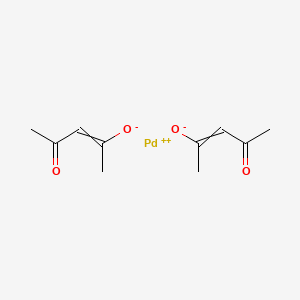
CAS · 14024-61-4
Product Overview
Palladium(II) acetylacetonate is a high-purity catalysts-auxiliary-agent supplied for industrial and specialty chemical applications. Contact our team for specifications, packaging options and lead times.
Product Specifications
| Appearance: | Yellow powder |
|---|---|
| Assay (Pd): | 34.5% min |
| Solubility: | The product contains less than 0.5% chloroform |
| Purity: | 98% min |
Applications
1. Catalyst Precursor in Homogeneous and Heterogeneous Catalysis
Pd(acac)₂ is a versatile and widely employed palladium source in catalytic chemistry. It is soluble in many organic solvents and can be converted under reaction conditions into active palladium catalysts.
Cross-Coupling Reactions: It is a common precursor for catalysts used in Suzuki, Heck, Sonogashira, Stille, and Negishi coupling reactions. These reactions form carbon-carbon bonds and are fundamental in pharmaceutical and fine chemical synthesis.
Hydrogenation and Carbonylation: Palladium complexes derived from Pd(acac)₂ catalyze selective hydrogenation of olefins, carbonylation reactions, and other transformations important in organic synthesis.
C–H Activation: Used in emerging catalytic methods that functionalize C–H bonds directly, improving the efficiency and atom economy of synthetic routes.
2. Preparation of Palladium Nanoparticles
Pd(acac)₂ serves as a precursor in the synthesis of palladium nanoparticles and nanocatalysts.
Nanomaterials for Catalysis: Controlled thermal decomposition or reduction of Pd(acac)₂ leads to the formation of Pd nanoparticles, which exhibit high surface area and catalytic activity.
Fuel Cell Catalysts: Pd nanoparticles prepared from Pd(acac)₂ are used as electrocatalysts in hydrogen fuel cells and other energy applications.
3. Material Science and Thin Film Deposition
Pd(acac)₂ is used in chemical vapor deposition (CVD) and atomic layer deposition (ALD) techniques to prepare thin films of palladium.
Coatings and Electronic Devices: These palladium films are employed in electronics, sensors, and corrosion-resistant coatings.
Microelectronics: Thin palladium layers deposited from Pd(acac)₂ precursors are important in microelectronic component fabrication.
4. Synthesis of Organopalladium Complexes
Pd(acac)₂ is used as a starting material to synthesize various organometallic palladium complexes, which act as catalysts or reagents in organic transformations.
Ligand Exchange Reactions: The acetylacetonate ligands can be replaced with phosphines, N-heterocyclic carbenes (NHCs), or other ligands to tailor the catalyst properties.
5. Pharmaceutical and Fine Chemical Synthesis
Due to its role in palladium-catalyzed coupling and hydrogenation reactions, Pd(acac)₂ is critical in the synthesis of complex organic molecules including active pharmaceutical ingredients (APIs).
Benefits
1. Stable and Easy to Handle
Pd(acac)₂ is relatively stable compared to other palladium salts and complexes. It can be stored and handled easily under standard laboratory conditions without rapid degradation.
2. Good Solubility in Organic Solvents
Its solubility in common organic solvents like toluene, chloroform, and benzene facilitates its use as a homogeneous catalyst precursor, allowing for better dispersion and activity.
3. Versatile Catalyst Precursor
Pd(acac)₂'s ability to form a variety of palladium species under reaction conditions makes it highly versatile. It can generate active catalytic species for multiple types of reactions, increasing its utility across many chemical processes.
4. Efficient Catalyst Activation
Compared to other palladium sources, Pd(acac)₂ often allows for milder reaction conditions and higher catalytic efficiency in cross-coupling and hydrogenation reactions, reducing energy consumption and improving yield.
5. Precursor for Advanced Nanomaterials
Its use in nanoparticle synthesis supports advances in catalysis and energy technologies, including fuel cells and green chemistry applications.
Conclusion
Palladium(II) acetylacetonate (CAS 14024-61-4) is a crucial palladium complex widely used as a catalyst precursor in organic synthesis, materials science, and nanotechnology. Its stability, solubility, and catalytic versatility make it indispensable in cross-coupling reactions, nanoparticle preparation, and thin film deposition. These properties facilitate the development of pharmaceuticals, fine chemicals, and advanced materials, enhancing reaction efficiency and enabling novel catalytic processes.
Previous
Next