
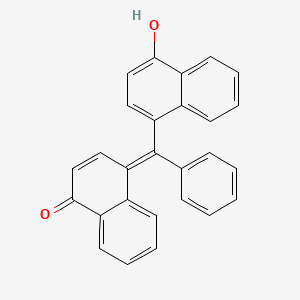
CAS · 145-50-6
Product Overview
p-Naphtholbenzein is a high-purity dyes-pigments supplied for industrial and specialty chemical applications. Contact our team for specifications, packaging options and lead times.
Product Specifications
| Description | Dark Pink to Red to Red-Brown to Brown powder |
|---|---|
| Melting Point | 237 to 240℃ |
| Absorptivity 1%/1cm (in 0.01 N NaOH) @λmax | 644.0 to 656 nm |
| Visual Transition Interval | From pH 8.2 (Orange-Yellow) to pH 10.0 (Blue to Blue-green) |
Applications
1. Analytical Chemistry – Complexometric Indicator
p-Naphtholbenzein is widely used as a complexometric indicator in EDTA titrations, especially for the detection and quantification of metal ions like:
● Calcium (Ca²⁺)
● Magnesium (Mg²⁺)
● Zinc (Zn²⁺)
● Copper (Cu²⁺)
● Lead (Pb²⁺)
The indicator forms colored complexes with metal ions, and during titration, the color change signals the endpoint of the reaction. This application is crucial in:
● Water hardness testing
● Pharmaceutical quality control
● Environmental monitoring
2. pH Indicator and Metal Ion Detector
Due to its azo chromophore and phenolic groups, p-Naphtholbenzein exhibits pH-dependent color changes and can function as a pH indicator within certain acidic or basic ranges. Additionally, it reacts with transition metals, making it useful in spectrophotometric assays for metal ion detection.
3. Synthesis of Metal Complexes
p-Naphtholbenzein acts as a chelating ligand, forming stable complexes with various metal ions. It is often used in:
● Coordination chemistry research
● Modeling of enzyme-metal active sites
● Studies of electronic transitions in metal–ligand complexes
These metal complexes can have applications in:
● Catalysis
● Electronic materials
● Optical sensors
4. Dye and Pigment Applications
As a member of the azo dye class, p-Naphtholbenzein has been used as a:
● Synthetic dye intermediate
● Colorant in textile and pigment industries (historically, more than currently)
● Color standard or reference dye in laboratory applications
Though it is not as widely used as modern dyes for commercial coloring purposes, it serves an educational and research role in dye chemistry.
5. Educational and Demonstration Use
In university and high school laboratories, p-Naphtholbenzein is used in:
● Demonstrations of azo coupling reactions
● Teaching principles of acid-base indicators
● Metal complexation studies
Its visually striking color changes and ability to bind selectively to metals make it ideal for instructional experiments.
Benefits
1. High Sensitivity in Metal Detection
p-Naphtholbenzein丨CAS 145-50-6 forms deeply colored complexes, allowing for easy visual detection and spectrophotometric quantification of trace metal ions.
2. Reliable Titration Indicator
Its distinct color change at metal saturation points makes it ideal for accurate and precise titrations, especially in water quality and environmental analysis.
3. Versatile Ligand Chemistry
The molecule contains multiple donor atoms (hydroxyl and azo nitrogen), allowing for bidentate or tridentate coordination, useful in studying transition metal complexation.
4. Educational Value
Its ability to vividly demonstrate:
● Color changes with pH
● Metal ion binding
● Azo coupling chemistry
Makes it a popular reagent in teaching laboratories.
Conclusion
A concise summary and suitability assessment for this product is available on request. Contact our team to discuss whether it fits your process and quality requirements.