
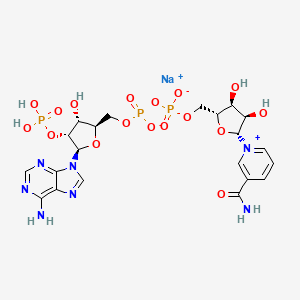
CAS · 1184-16-3
Product Overview
Nadide phosphate monosodium is a high-purity pharmaceutical-intermediates supplied for industrial and specialty chemical applications. Contact our team for specifications, packaging options and lead times.
Product Specifications
| Appearance: | White to off-white powder |
|---|---|
| Purity (HPLC): | 95% min |
| NADP Content (dry basis, Enzymatic analysis): | 90% min |
| Water Content (KF): | 5% max |
| Sodium Content (IC): | 2–4% |
| pH Value in Water (100mg/ml, GE): | 2–4 |
| Spectral Analysis: 1. ε at 260nm and pH 7.5: | (18.0 ± 1.8) × 10³ L/mol/cm |
| 2. Ratio at pH 7.5: A250/A260: | 0.83 ± 0.08 |
| A280/A260: | 0.21 ± 0.02 |
| 3. ε when reduced with G-6-PDH at 340nm and pH 7.5: | (6.2 ± 0.6) × 10³ L/mol/cm |
| 4. A340/A260 when reduced with G-6-PDH at pH 7.5: | 0.43 ± 0.04 |
Applications
1. Biochemistry and Molecular Biology
a. Coenzyme in Redox Reactions
● Nadide phosphate monosodium丨CAS 1184-16-3 functions as a vital electron carrier in numerous biochemical reactions.
● It exists in oxidized (NADP⁺) and reduced (NADPH) forms.
● It acts as a coenzyme for various dehydrogenases, especially in anabolic reactions like fatty acid and nucleic acid synthesis.
b. Enzyme Assays and Research
● Extensively used in in vitro enzyme activity assays, especially those involving oxidoreductases.
● Used to study metabolic pathways such as the pentose phosphate pathway and Calvin cycle.
c. Cell Culture and Biotechnology
● Supplemented in cell-free systems or in vitro transcription-translation reactions.
● Used in synthetic biology for designing enzymatic reactions and biosensors.
2. Pharmaceutical and Clinical Research
a. Oxidative Stress Studies
● NADPH, the reduced form of NADP⁺, is a critical part of the antioxidant defense system, involved in the regeneration of glutathione and other antioxidants.
● Used in studies related to aging, neurodegeneration, cardiovascular diseases, and cancer, where redox balance is crucial.
b. Drug Development
● Assists in screening enzyme inhibitors or activators by acting as a coenzyme in targeted metabolic pathways.
● Plays a role in personalized medicine research, particularly related to metabolism and mitochondrial function.
3. Food and Nutraceutical Industry
● Although not directly added to foods, Nadide phosphate monosodium丨CAS 1184-16-3 is studied in the context of nutritional biochemistry.
● Its precursors (such as niacin) are essential vitamins that support coenzyme biosynthesis.
● Important in the evaluation of cellular energy status and metabolic function in functional food research.
4. Cosmetic and Anti-Aging Applications
● NADP⁺ and its derivatives are increasingly explored in cosmeceuticals.
● Involved in cellular repair processes and anti-aging formulations due to its role in redox balance and DNA repair.
● Supports skin metabolism, particularly in maintaining moisture and protection against oxidative damage.
5. Agricultural and Environmental Research
a. Plant Physiology
● Plays a key role in photosynthesis, especially in the Calvin cycle where NADPH is used in carbon fixation.
● Studied to enhance crop yield and stress resistance in plants under environmental stress (drought, salinity).
b. Bioremediation
● Enzymes that use NADP⁺/NADPH as cofactors are used in microbial degradation of pollutants.
● Useful in biocatalytic processes involving xenobiotic transformations.
Benefits
1. Supports Anabolic Reactions
Nadide phosphate monosodium丨CAS 1184-16-3 is an essential coenzyme in biosynthetic reactions, especially those forming lipids, nucleotides, and cholesterol. It provides the reducing power (NADPH) necessary for these pathways.
2. Enhances Antioxidant Defense
Through its role in regenerating antioxidants like glutathione, NADPH helps protect cells against oxidative stress, supporting cellular health and longevity.
3. Crucial in Energy and Metabolic Homeostasis
Maintains cellular redox balance, crucial for ATP production, mitochondrial health, and overall metabolism.
4. Facilitates Research and Innovation
As a biochemical standard, it enables accurate measurement of enzymatic activity, metabolic profiling, and the design of metabolic engineering systems.
5. Promotes Skin and Cellular Vitality
NADP⁺-related cofactors are investigated for their role in skin rejuvenation, repair, and UV protection, contributing to next-generation anti-aging therapies.
Conclusion
Nadide phosphate monosodium丨CAS 1184-16-3 is far more than a chemical compound-it's a cornerstone molecule in biology and biotechnology. From enabling critical redox reactions in living cells to advancing drug development, metabolic engineering, and anti-aging science, its applications are both broad and impactful.
Previous
Tert-Butyl 4,7-diazaspiro(2.5)octane-4-carboxylate丨CAS 674792-08-6
Next
Conclusion
A concise summary and suitability assessment for this product is available on request. Contact our team to discuss whether it fits your process and quality requirements.