CAS · 214750-74-0
Product Overview
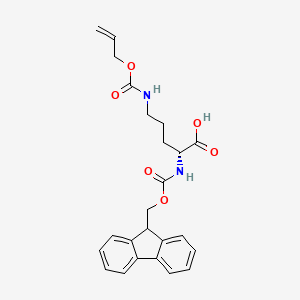
N-Fmoc-N-allyloxycarbonyl-D-ornithine is a high-purity amino-acids supplied for industrial and specialty chemical applications. Contact our team for specifications, packaging options and lead times.
Product Specifications
| Appearance | White powder |
|---|---|
| Purity (HPLC) | 98% min |
| Optical Purity | 0.5% L-enantiomer max |
| Specific Rotation [α]20/D | +8.5° ± 1° (C=1 in DMF) |
| Melting Point | 100–120°C |
| Clarity of solution | 0.3 gram in 2 mL DMF clear solution |
| Water Content (K.F.) | 1% max |
| Loss on drying | 2.0% max (50°C, 2h) |
| IR Spectrum | In accordance with the structure |
| Mass Spectrum | In accordance with the structure |
| NMR Spectrum | In accordance with the structure |
Applications
N-Fmoc-N-allyloxycarbonyl-D-ornithine is a protected chiral amino acid widely used in peptide synthesis, medicinal chemistry, and chemical biology research. It serves as a key building block for constructing peptides, peptidomimetics, and cyclic peptides where selective protection of amino groups is required. The Fmoc and allyloxycarbonyl (Alloc) protecting groups allow orthogonal deprotection strategies, enabling stepwise peptide elongation and incorporation of functionalized residues without undesired side reactions. In pharmaceutical research, it is applied in the design and synthesis of bioactive peptides, enzyme inhibitors, and receptor ligands where D-ornithine residues contribute to structural rigidity, enhanced stability, and stereochemical control. Additionally, the compound is used in combinatorial chemistry and solid-phase peptide synthesis for the generation of diverse peptide libraries and structure–activity relationship studies.
Benefits
The benefits of N-Fmoc-N-allyloxycarbonyl-D-ornithine arise from its dual protection strategy, defined stereochemistry, and chemical versatility. The Fmoc group allows base-mediated removal, while the Alloc group can be selectively cleaved under mild conditions, enabling precise control over peptide assembly. The D-ornithine backbone provides stereochemical integrity, improving peptide stability against enzymatic degradation and influencing secondary structure formation. The compound is compatible with common coupling reagents, solvents, and solid-phase synthesis protocols, facilitating high-efficiency peptide elongation and reproducibility. Its high purity and well-characterized properties ensure consistent performance in laboratory and preclinical applications, supporting reliable synthesis of complex peptides.
Conclusion
N-Fmoc-N-allyloxycarbonyl-D-ornithine is a versatile and valuable protected amino acid intermediate for peptide synthesis, medicinal chemistry, and biochemical research. Its orthogonal protection, stereochemical definition, and synthetic compatibility enable efficient construction of stable and bioactive peptides. By supporting precise peptide assembly, structural optimization, and functional exploration, this compound continues to play an essential role in modern peptide chemistry, drug discovery, and therapeutic research.
Previous
Next