
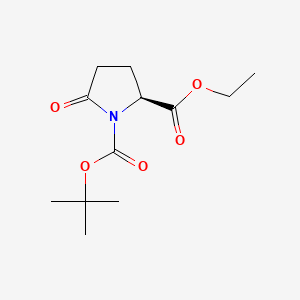
CAS · 144978-12-1
Product Overview
N-Boc-L-pyroglutamic acid ethyl ester is a high-purity amino-acids supplied for industrial and specialty chemical applications. Contact our team for specifications, packaging options and lead times.
Product Specifications
| Appearance | White or off-white powder |
|---|---|
| Specific Rotation (α)20/D | -43° to -39° (c = 2, Ethanol) |
| Purity (HPLC) | 98% min |
| Water | 0.5% max |
Applications
N-Boc-L-pyroglutamic acid ethyl ester (CAS 144978-12-1) is a protected amino acid derivative commonly used as a synthetic intermediate in pharmaceutical and peptide chemistry. The Boc (tert-butoxycarbonyl) group protects the amino functionality, while the ethyl ester safeguards the carboxyl group, enabling selective transformations during multi-step synthesis. It is widely applied in the preparation of modified peptides, peptidomimetics, and small-molecule drug candidates, where pyroglutamic acid motifs play roles in stability and bioactivity. In addition, it serves as a building block for designing compounds in medicinal chemistry, agrochemicals, and fine chemical research, supporting the development of molecules with enhanced structural diversity and therapeutic potential.
Benefits
The benefits of N-Boc-L-pyroglutamic acid ethyl ester arise from its stability, versatility, and ease of deprotection. Both protecting groups can be removed under controlled conditions, allowing chemists to tailor synthetic pathways with high precision and efficiency. The pyroglutamic acid core provides a rigid, conformationally constrained scaffold that enhances peptide stability and can improve pharmacological properties of resulting compounds. Its dual-protected form prevents unwanted side reactions, streamlining complex syntheses and improving overall yields. Additionally, its compatibility with both laboratory-scale and industrial-scale synthesis makes it a practical choice for advancing research and development in multiple chemical fields.
Conclusion
In conclusion, N-Boc-L-pyroglutamic acid ethyl ester is a valuable intermediate in peptide and pharmaceutical synthesis, offering controlled reactivity and structural versatility. Its applications include peptide modification, drug discovery, and fine chemical development, while its benefits center on synthetic efficiency, scaffold stability, and process reliability. As modern medicinal chemistry continues to pursue novel therapeutic scaffolds and optimized drug candidates, this compound remains a key enabler of precise and efficient molecular design.
Previous
Next