
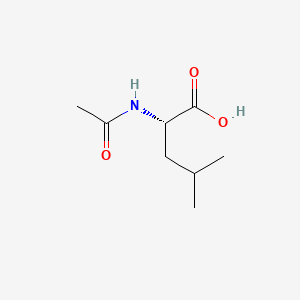
CAS · 1188-21-2
Product Overview
N-Acetyl-L-leucine is a high-purity pharmaceutical-intermediates supplied for industrial and specialty chemical applications. Contact our team for specifications, packaging options and lead times.
Product Specifications
| Property | Specification |
|---|---|
| Appearance | White to off-white powder |
| Iron (Fe) | 10 ppm max |
| Chloride (Cl) | 0.02% max |
| Heavy Metals (Pb) | 20 ppm max |
| Specific Rotation 20/D (C=4 in methanol) | -22 ~ -26 deg |
| State of Solution (Transmittance) | 98% min |
| Assay | 98% ~ 102% |
| Loss on Drying (At 105℃, under vacuum for 3hrs) | 0.35% max |
| Arsenic (As2O3) | 2 ppm max |
| Residue on Ignition | 0.2% max |
Applications
1. Cognitive and Neurological Health
One of the primary applications of N-acetyl-L-leucine is in the area of neurological health. It has shown potential as a cognitive enhancer and has been investigated for its ability to aid in cognitive function and memory improvement. The acetylation of leucine increases its permeability to the blood-brain barrier (BBB), potentially improving its effectiveness as a cognitive support agent.
● Neuroprotective Effects: Studies suggest that N-acetyl-L-leucine may exhibit neuroprotective properties by influencing pathways involved in neurodegenerative diseases like Alzheimer's disease or Parkinson's disease. It could potentially support neuroplasticity and neurogenesis, essential for healthy brain function.
● Treatment of Cognitive Decline: Due to its impact on brain metabolism and its ability to support neurotransmitter balance, N-acetyl-L-leucine may be useful in treating age-related cognitive decline or memory disorders. Some preliminary research points to it as a potential treatment for mild cognitive impairment (MCI).
2. Muscle Health and Exercise Performance
Given the vital role of L-leucine in muscle metabolism, the acetylated form, N-acetyl-L-leucine, has potential benefits in enhancing muscle recovery and promoting muscle growth. Leucine is known to stimulate the mTOR pathway, a key regulator of muscle protein synthesis.
● Exercise Recovery: Athletes and bodybuilders may find N-acetyl-L-leucine useful as a supplement to improve muscle recovery after intense physical activity. It can help reduce muscle soreness and accelerate the repair process by promoting the synthesis of new muscle proteins.
● Protein Synthesis: As a leucine derivative, N-acetyl-L-leucine also supports protein synthesis and is believed to contribute to muscle mass development, especially when combined with other amino acids or protein supplements in exercise regimens.
3. Fatigue and Energy Metabolism
N-Acetyl-L-leucine丨1188-21-2 has been investigated for its fatigue-reducing effects, particularly in individuals experiencing chronic fatigue or generalized weakness. Due to its influence on amino acid metabolism and cellular energy production, N-acetyl-L-leucine may help alleviate symptoms of fatigue by boosting energy levels at the cellular level.
● Chronic Fatigue Syndrome (CFS): There is ongoing research into its role in treating Chronic Fatigue Syndrome (CFS), a condition that results in persistent fatigue that is not alleviated by rest. Some studies suggest that its ability to regulate metabolic pathways could improve energy production at the cellular level, helping individuals feel less fatigued.
● Energy and Endurance: The compound could also have benefits for improving endurance during physical activity by supporting fatigue resistance. It may be a beneficial supplement for those engaged in endurance sports like long-distance running or cycling.
4. Treatment of Dizziness and Vertigo
N-Acetyl-L-leucine丨1188-21-2 has been explored for its therapeutic effects in treating conditions like dizziness and vertigo. Some studies have shown that N-acetyl-L-leucine may help reduce symptoms of vestibular disorders by enhancing neuronal function and balance mechanisms within the brain.
● Vestibular System Support: It is believed that N-acetyl-L-leucine can help in restoring balance and reducing vertigo symptoms, especially in conditions related to the inner ear or balance disorders. This makes it a potential treatment for conditions such as Ménière's disease and benign paroxysmal positional vertigo (BPPV).
5. Acetylation as a Drug Delivery Strategy
The acetyl group attached to the leucine molecule improves the solubility and bioavailability of N-acetyl-L-leucine. This feature can be exploited in drug delivery systems, where the acetylation enhances the absorption of the compound in the intestinal tract and its passage across the blood-brain barrier.
● Improved Bioavailability: The acetylation helps in enhancing the absorption of the compound in pharmaceutical formulations. As a result, N-acetyl-L-leucine can be more effective than its parent amino acid in delivering therapeutic effects, especially in neurodegenerative and muscle-related disorders.
6. Skin Health and Anti-Aging
Although not widely studied, N-Acetyl-L-leucine丨1188-21-2 may have some benefits for skin health due to its role in protein synthesis and potential to improve the structural integrity of skin cells. Leucine itself is essential for collagen production and skin cell turnover, and its acetylated form could support these processes.
● Collagen Production: Collagen is essential for maintaining skin elasticity and firmness. N-acetyl-L-leucine could potentially enhance collagen synthesis, which may contribute to the anti-aging benefits by reducing wrinkles and improving skin tone.
● Anti-Inflammatory Effects: Due to its ability to modulate cellular processes, it might have anti-inflammatory properties that help in reducing skin inflammation, aiding in wound healing, and improving skin texture.
Benefits
1.Cognitive Enhancement: May improve memory, focus, and overall cognitive function, potentially benefiting people with neurodegenerative conditions like Alzheimer's disease.
2.Muscle Recovery: Helps accelerate recovery after exercise, supports muscle growth, and reduces soreness.
3.Fatigue Reduction: Assists in combating chronic fatigue, particularly in people suffering from conditions like Chronic Fatigue Syndrome.
4.Vestibular Health: Potentially aids in treating dizziness and vertigo, supporting balance and brain function related to the inner ear.
5.Improved Bioavailability: The acetyl group enhances its absorption and effectiveness in both pharmaceutical and nutritional supplements.
6.Potential Anti-Aging: May improve skin health and contribute to anti-aging effects by supporting collagen production and reducing inflammation.
Conclusion
N-Acetyl-L-leucine丨1188-21-2 is a promising compound with a variety of potential therapeutic applications. Its ability to cross the blood-brain barrier, enhance muscle recovery, reduce fatigue, and support cognitive function makes it a compound of interest for treating a wide range of health conditions. While the compound holds promise in pharmaceutical and wellness sectors, ongoing research is essential to better understand its mechanisms and broader applications.
Previous
N-Acetyl-D-mannosamine丨CAS 7772-94-3
Next