
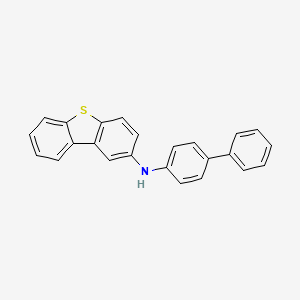
CAS · 1300028-93-6
Product Overview
N-(1,1-biphenyl-4-yl)dibenzob,dthiophen-2-amine is a high-purity oled-materials supplied for industrial and specialty chemical applications. Contact our team for specifications, packaging options and lead times.
Product Specifications
| Appearance: | Brown powder |
|---|---|
| Purity (HPLC): | 99% min |
| Melting Point (MP): | 170.0~173.0 °C |
Applications
1. Organic Light-Emitting Diodes (OLEDs)
This compound is frequently used as a hole-transport material (HTM) or host material in OLED devices due to its excellent electronic properties, thermal stability, and molecular rigidity. The nitrogen-linked aryl systems facilitate efficient charge transport and emission.
2. Organic Photovoltaics (OPVs)
Its conjugated structure enables good light absorption and charge mobility, making it a valuable component in organic solar cells as a donor or interface material in active layers.
3. Organic Semiconductors
The compound is suitable for use in OFETs (Organic Field Effect Transistors) and other organic semiconducting devices, where high charge-carrier mobility and stability are required.
4. Functional Materials Research
Used in the development of advanced π-conjugated systems for materials with tailored optical, electronic, and photophysical properties.
Benefits
Enhanced Charge Mobility: The nitrogen linkage and conjugated aromatic systems support effective hole transport and electron delocalization.
Thermal and Chemical Stability: Aromatic rings and sulfur-containing heterocycles offer durability under operating conditions in devices.
Versatile Functionalization: The biphenyl and dibenzothiophene structures can be further modified, allowing tuning of electronic and solubility characteristics.
High Purity and Performance: Its defined structure and high-performance characteristics make it suitable for demanding electronic applications.
Conclusion
N-(1,1-Biphenyl-4-yl)dibenzo[b,d]thiophen-2-amine (CAS 1300028-93-6) is a high-value molecule in the field of organic electronics. Its extended π-conjugated system, thermal stability, and excellent charge transport capabilities make it ideal for use in OLEDs, OPVs, and other organic semiconducting devices. As the demand for high-performance organic materials continues to grow, this compound serves as a foundational building block for next-generation optoelectronic technologies.
Previous
9-(1,1-biphenyl-3-yl)-3-(4,4,5,5-tetramethyl-1,3,2-dioxaborolan-2-yl)-9H-carbazole丨CAS 1533406-38-0
Next