
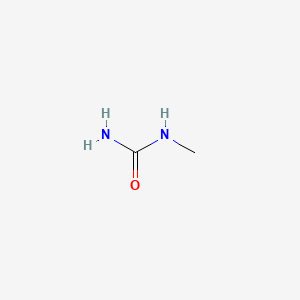
CAS · 598-50-5
Product Overview
Methylurea is a high-purity pesticide-intermediate supplied for industrial and specialty chemical applications. Contact our team for specifications, packaging options and lead times.
Product Specifications
| Appearance | Off-white crystalline granular |
|---|---|
| Purity | 98% min. |
| Loss on drying | 1.0% max. |
Applications
Methylurea is extensively used as a synthetic intermediate in multiple industries. In pharmaceutical chemistry, it serves as a building block for urea-based drugs, including antiviral, anticancer, and enzyme inhibitor candidates. Its functional groups allow the construction of heterocyclic compounds, such as triazines, pyrimidines, and other nitrogen-rich scaffolds commonly found in bioactive molecules. In agrochemicals, methylurea derivatives are employed in the production of herbicides, fungicides, and pesticides due to their ability to confer improved water solubility, reactivity, and environmental stability. In materials science, methylurea is used in resin and polymer synthesis; its urea moiety facilitates crosslinking reactions, enhancing the thermal and mechanical properties of coatings, adhesives, and specialty polymers. Additionally, in laboratory research, methylurea is utilized as a reagent for studying condensation reactions, derivatization of amines, and preparation of advanced nitrogen-containing intermediates, enabling the discovery of new chemical entities.
Benefits
The advantages of methylurea stem from its chemical reactivity, small molecular size, and multifunctionality. Its urea group allows hydrogen bonding, which can improve solubility in water and organic solvents, making it easier to formulate into various reaction systems. The methyl substitution adds steric and electronic effects, enabling selective reactions and reducing unwanted side products in multi-step syntheses. Methylurea is chemically stable under standard storage conditions, resistant to hydrolysis, and compatible with a wide range of catalysts, solvents, and reaction conditions. Its versatility enables chemists to use it as a precursor for diverse chemical transformations, including alkylation, acylation, and cyclization reactions. Additionally, the compound's cost-effectiveness and ease of handling make it practical for both industrial-scale production and research applications.
Conclusion
Methylurea is a highly versatile urea derivative that plays an important role across pharmaceuticals, agrochemicals, materials science, and organic research. Its combination of reactivity, solubility, and chemical stability allows it to act as a key intermediate for the synthesis of bioactive compounds, heterocycles, resins, polymers, and specialty chemicals. With its multifunctional nature and adaptability in diverse chemical reactions, methylurea remains an essential building block in modern organic synthesis, supporting innovation in both industrial applications and laboratory research.
Previous
Next