
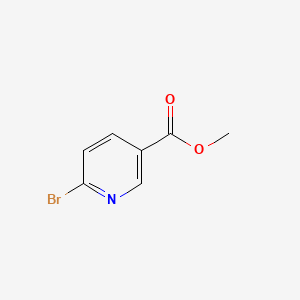
CAS · 26218-78-0
Product Overview
Methyl 6-bromonicotinate is a high-purity pharmaceutical-intermediates supplied for industrial and specialty chemical applications. Contact our team for specifications, packaging options and lead times.
Product Specifications
| Appearance: | White solid |
|---|---|
| Purity (LC): | 98% min |
| Water: | 0.5% max |
| Single impurity: | 0.5% max |
Applications
1. Pharmaceutical Intermediate
Methyl 6-bromonicotinate is a valuable building block in the synthesis of heterocyclic drugs and active pharmaceutical ingredients (APIs):
Key intermediate for pyridine-containing drug scaffolds: The bromine atom serves as a reactive site for palladium-catalyzed cross-coupling reactions such as Suzuki, Sonogashira, or Buchwald–Hartwig amination.
Used in kinase inhibitors, antiviral, and anti-inflammatory drug candidates: The pyridine ring plays a role in molecular recognition and target binding.
The methyl ester group can be easily hydrolyzed to the acid or transformed into amides, hydrazides, or other derivatives, expanding the synthetic versatility.
2. Agrochemical Synthesis
Serves as a precursor in the synthesis of pyridine-based herbicides, fungicides, and plant growth regulators.
Halopyridines, including 6-bromonicotinate derivatives, are known to be bioactive cores in crop protection chemistry due to their interaction with plant enzymes or pests' nervous systems.
3. Cross-Coupling Chemistry
The bromine at position 6 allows the molecule to be a coupling partner in Pd-catalyzed reactions for:
Attaching aryl, alkyl, or heteroaryl groups
Constructing diverse biaryl systems, which are common in drug and material science
4. Medicinal Chemistry and Lead Optimization
Extensively used in structure-activity relationship (SAR) studies to develop new analogs with improved potency and selectivity.
Enables medicinal chemists to explore substitution effects at the 6-position of pyridine, influencing receptor binding and metabolic stability.
5. Materials Chemistry
As a functionalized pyridine derivative, it may be used in the design of:
Ligands for coordination complexes
Building blocks in organic electronics or optical materials
Intermediates in the development of functionalized polymers or dyes
Benefits
1. Synthetic Versatility
Bromine group: Allows for a wide variety of substitution via well-established cross-coupling methodologies (e.g., Suzuki–Miyaura, Stille, Heck).
Ester functionality: Enables derivatization into carboxylic acids, amides, hydrazides, and hydroxamic acids, supporting molecular diversity.
2. Facilitates Efficient Molecule Assembly
Useful in modular synthesis strategies where heterocycles are constructed in a stepwise manner.
Provides access to multi-functionalized pyridine cores, crucial in medicinal chemistry for target affinity and bioavailability.
3. Good Stability and Handling
Stable under normal storage and laboratory conditions.
Typically available as a solid or crystalline powder, making it easy to weigh, store, and handle in both small-scale and industrial synthesis.
4. Commercial Availability
Widely available from chemical suppliers in research-grade and bulk quantities, supporting its use in both early-stage discovery and scale-up production.
5. Applicable to Green Chemistry Approaches
Compatible with microwave-assisted synthesis, solvent-free reactions, and other environmentally friendly reaction protocols.
Conclusion
Methyl 6-bromonicotinate (CAS 26218-78-0) is a highly versatile and functionalized pyridine intermediate that plays an important role in pharmaceutical, agrochemical, and material science research. Its bromine atom enables diverse coupling reactions, while the ester group offers flexible derivatization pathways. The compound supports the rapid development of heterocyclic compounds, especially those containing biologically or agriculturally active pyridine motifs. Thanks to its stability, reactivity, and broad applicability, it is an essential building block in modern synthetic organic chemistry.
Previous
4-Isopropylbenzoic Acid丨CAS 536-66-3
Next