
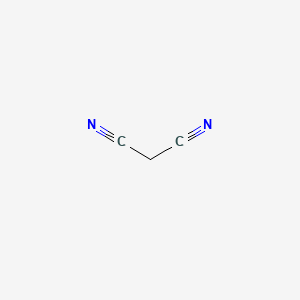
CAS · 109-77-3
Product Overview
Malononitrile is a high-purity pesticide-intermediate supplied for industrial and specialty chemical applications. Contact our team for specifications, packaging options and lead times.
Product Specifications
| Appearance (under 30°C) | Colorless or yellowish crystalline solid or liquid |
|---|---|
| Content | 99% min |
| Crystallization point | 31-32°C |
| Acid (calculated based on HCl) | 0.3% max |
| Residue on ignition | 0.05% max |
Applications
Malononitrile is widely used as a versatile intermediate in organic synthesis, pharmaceuticals, and material sciences. It serves as a key building block for the synthesis of heterocyclic compounds, dyes, agrochemicals, and fine chemicals. In pharmaceutical chemistry, it is employed to construct biologically active molecules such as pyrimidines, pyridines, and other nitrogen-containing heterocycles. Malononitrile is also used in the production of specialty polymers, organic electronics, and as a reagent in Knoevenagel condensation reactions for forming carbon-carbon double bonds in complex molecules.
Benefits
The main benefits of malononitrile include its high reactivity due to the presence of two electron-withdrawing nitrile groups, which facilitate a wide range of chemical transformations. Its utility in synthesizing heterocyclic and functionalized organic compounds allows for efficient production of pharmaceuticals, dyes, and advanced materials. Malononitrile is stable under standard storage conditions, soluble in common organic solvents, and compatible with multi-step syntheses, making it an indispensable intermediate in both laboratory and industrial chemistry.
Conclusion
Malononitrile is a highly valuable intermediate in chemical synthesis with broad applications across pharmaceuticals, agrochemicals, dyes, and materials science. Its reactivity, versatility, and stability make it an essential tool for chemists developing heterocyclic compounds, functional materials, and fine chemicals. The compound's role in efficient multi-step syntheses ensures its continued importance in modern synthetic chemistry.
Previous
Next