
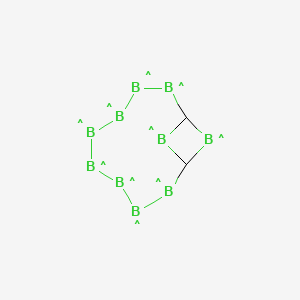
CAS · 16986-24-6
Product Overview
m-Carborane is a high-purity borane supplied for industrial and specialty chemical applications. Contact our team for specifications, packaging options and lead times.
Product Specifications
| Appearance: | Light yellow to white crystals |
|---|---|
| Assay: | 97%min |
| Clarity: | No more than No. 0.5 turbidity |
Applications
1. Advanced Material Design and High-Performance Polymers
m-Carborane's thermal and oxidative stability allows it to serve as a component in advanced polymers and composite materials:
Used in high-temperature resins, ceramic precursors, and thermosetting materials for aerospace, military, and electronics industries.
Incorporated into flame-retardant materials or thermally stable coatings.
Enhances mechanical strength, thermal resistance, and chemical durability when embedded in polymer chains.
2. Boron Neutron Capture Therapy (BNCT)
m-Carborane is rich in boron-10 and is used as a boron delivery agent in BNCT, a cancer treatment that selectively destroys tumor cells using neutron irradiation.
Selective targeting: m-Carborane derivatives can be modified with biomolecules (e.g., peptides, sugars, antibodies) to selectively accumulate in tumors.
Non-toxic carrier: The core m-carborane cluster is chemically stable and biologically compatible with low systemic toxicity.
3. Ligands in Organometallic and Coordination Chemistry
m-Carborane can form carboranyl ligands, which offer unique steric and electronic properties:
Used in transition-metal complexes with improved thermal and chemical stability.
Allows design of electron-rich or electron-deficient coordination environments.
Applied in homogeneous catalysis, especially in cross-coupling reactions, hydrogenations, and olefin polymerization.
4. Pharmaceutical and Medicinal Chemistry
m-Carborane is explored as a bioisosteric replacement for phenyl groups in drug molecules:
Enhances metabolic stability and lipophilicity.
Used in enzyme inhibitors, hormone analogs, and targeted drug delivery systems.
Can be functionalized to interact with biological macromolecules or improve membrane permeability.
5. Optoelectronics and Electronic Materials
Its electron-deficient, rigid, and sterically bulky framework makes m-carborane useful in organic electronic applications:
Incorporated into organic light-emitting diodes (OLEDs), organic semiconductors, and nonlinear optical materials.
Modulates electronic band gaps, charge mobility, and photophysical behavior.
6. Chemical Sensors and Functionalized Surfaces
m-Carborane derivatives can be used in the design of:
Chemical sensors: Their high stability and electron-deficient properties support signal transduction mechanisms.
Self-assembled monolayers (SAMs) or functionalized surfaces: Provide robust chemical anchors or scaffolds for bioactive surfaces.
Benefits
1. High Thermal and Chemical Stability
Decomposes at very high temperatures (>400°C).
Chemically inert to acids, bases, oxidants, and most organic solvents.
2. High Boron Content for BNCT
With 10 boron atoms per molecule, it is ideal for boron delivery in therapeutic nuclear medicine.
Supports efficient neutron capture and selective cell killing when modified for tumor targeting.
3. Unique 3D Aromaticity
Exhibits three-dimensional aromaticity, contributing to:
Electron delocalization
Unusual bonding behavior
Stable cage-like structure
4. Synthetic Versatility
Allows selective functionalization at both carbon and boron vertices.
Amenable to reactions such as halogenation, lithiation, acylation, and metalation, enabling design of custom materials and pharmaceuticals.
5. Biocompatibility and Low Toxicity
Studies show low inherent toxicity, making m-carborane suitable for in vivo biomedical research.
Stable in biological environments, unlike many conventional organic structures.
6. Electron-Deficient Framework
Acts as an electron-withdrawing unit, tuning electronic behavior in catalysts, pharmaceuticals, and materials.
Useful in ligand design for electron-poor metal complexes.
Conclusion
m-Carborane (CAS 16986-24-6) is a highly stable, boron-rich, and electronically unique compound with diverse and growing applications across advanced materials, cancer therapy, catalysis, and electronics. Its combination of thermal resilience, synthetic flexibility, 3D aromaticity, and biocompatibility makes it a strategic molecule in the design of next-generation materials, targeted therapies, and high-performance molecular systems. Continued research and development in functionalization techniques and nanocarrier systems are expected to unlock even broader use of m-carborane in both industrial and medical technologies.
Previous
Next