
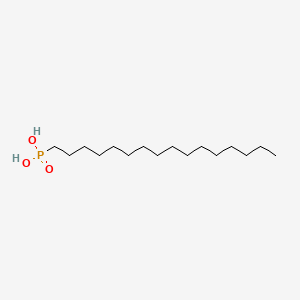
CAS · 4721-17-9
Product Overview
Hexadecylphosphonic Acid is a high-purity organophosphorus-compounds supplied for industrial and specialty chemical applications. Contact our team for specifications, packaging options and lead times.
Product Specifications
| Appearance | White to off-white crystal flakes |
|---|---|
| Purity | 98.0% min. |
| Loss on drying | 0.5% max. |
Applications
Hexadecylphosphonic acid is a long-chain alkylphosphonic acid widely used in surface modification, nanomaterials, and advanced coatings. It is particularly valuable for forming self-assembled monolayers (SAMs) on metal oxides such as titanium, aluminum, and zinc, improving surface hydrophobicity, adhesion, and chemical resistance. In materials science, it is employed to tailor surface properties of nanoparticles, thin films, and polymers, enabling applications in sensors, catalysis, and electronic devices. In corrosion protection, it enhances durability by creating stable protective layers on metal surfaces. Additionally, its amphiphilic structure makes it useful in surfactant systems, lubricants, and specialty formulations where long-chain hydrophobic interactions are advantageous.
Benefits
The benefits of hexadecylphosphonic acid stem from its strong binding affinity to metal oxide surfaces, structural versatility, and ability to impart functional surface characteristics. Its ability to form highly ordered and stable SAMs ensures long-lasting performance in protective and functional coatings. By improving hydrophobicity, wear resistance, and corrosion resistance, it supports advanced material design in electronics, optics, and industrial applications. Its compatibility with nanomaterials enhances dispersibility and functionalization, making it an essential tool in research and development of high-performance materials. Furthermore, its role in tailoring interfacial properties provides engineers and scientists with precise control over material performance.
Conclusion
Hexadecylphosphonic acid (CAS 4721-17-9) is a valuable compound in materials science, surface engineering, and specialty formulations. Its strong surface-binding capability, ability to form stable monolayers, and multifunctional benefits make it a critical reagent for creating advanced coatings, modifying nanomaterials, and enhancing corrosion resistance. With its wide-ranging applications and performance advantages, it remains an important material for both research and industrial innovation.
Previous
Butyltriphenylphosphonium Bromide丨CAS 1779-51-7
Next
2-(Dicyclohexylphosphino)-N2,N2,N6,N6-tetramethyl1,1-biphenyl-2,6-diamine丨CAS 1160556-64-8