
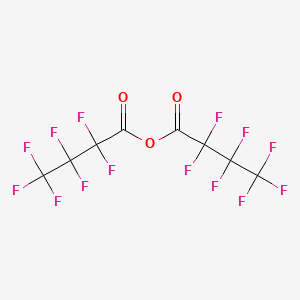
CAS · 336-59-4
Product Overview
Heptafluorobutyric anhydride is a high-purity biochemical-reagents supplied for industrial and specialty chemical applications. Contact our team for specifications, packaging options and lead times.
Product Specifications
| Appearance: | Colorless transparent liquid |
|---|---|
| Purity: | 90% min |
Applications
Heptafluorobutyric anhydride (HFBA) is a highly reactive fluorinated anhydride widely used in organic synthesis, analytical chemistry, and pharmaceutical development. It is commonly employed as a derivatization reagent in gas chromatography (GC) and mass spectrometry (MS) for improving the volatility, thermal stability, and detectability of polar compounds such as amines, alcohols, and carboxylic acids. In medicinal and fine chemical synthesis, HFBA is used to introduce perfluoroalkyl groups, which can enhance lipophilicity, metabolic stability, and bioavailability of drug candidates. Additionally, it serves as an acylating agent in the production of fluorinated esters, amides, and specialty intermediates for agrochemicals and high-performance materials.
Benefits
HFBA offers significant advantages due to its high reactivity and efficiency in derivatization and acylation reactions. Its perfluorinated structure enhances the volatility and electron-capturing properties of derivatives, resulting in improved analytical sensitivity and resolution in GC-MS applications. The compound is also stable under controlled conditions, allowing reproducible reactions and consistent product quality. Its use in pharmaceutical and fine chemical synthesis enables selective introduction of fluorinated groups, improving the pharmacokinetic and chemical properties of target molecules. Furthermore, HFBA facilitates rapid and high-yield transformations, reducing reaction times and optimizing synthetic workflows.
Conclusion
Heptafluorobutyric anhydride is a versatile and highly reactive reagent widely employed in analytical chemistry, pharmaceutical synthesis, and materials science. Its ability to enhance detectability in analytical methods, introduce fluorinated functional groups, and support efficient acylation reactions makes it an indispensable tool for research, development, and industrial applications.
Previous
Next