
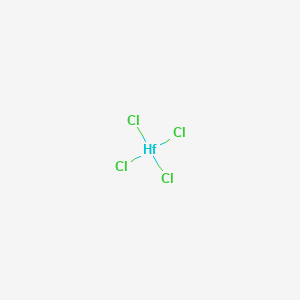
CAS · 13499-05-3
Product Overview
Hafnium tetrachloride is a high-purity electronic-chemicals supplied for industrial and specialty chemical applications. Contact our team for specifications, packaging options and lead times.
Product Specifications
| Appearance: | White or light granular |
|---|---|
| Assay wt%: | 99.9% min |
| Hf: | 55.728–57.2 |
| Al: | 0.0010% max |
| Ca: | 0.0015% max |
| Cu: | 0.0010% max |
| Fe: | 0.0020% max |
| Mg: | 0.0010% max |
| Mn: | 0.0010% max |
| Mo: | 0.0010% max |
| Nb: | 0.01% max |
| Ni: | 0.003% max |
| Si: | 0.005% max |
| Ti: | 0.001% max |
| V: | 0.001% max |
| Zn: | 0.001% max |
| Zr: | 0.02% max |
Applications
1. Semiconductor Industry
High-k Dielectric Material Precursor
● CVD and ALD Processes: Hafnium tetrachloride丨13499-05-3 is a key precursor for depositing hafnium dioxide (HfO₂) thin films, which are used as high-k dielectrics in microprocessors and memory chips.
● Gate Insulators in CMOS Devices: HfO₂ layers replace traditional SiO₂ in gate stacks of MOSFETs to reduce leakage currents and improve performance as transistors shrink to the nanometer scale.
2. Nuclear Applications
● Nuclear Reactor Control Components: Hafnium has an exceptional ability to absorb neutrons. Hafnium tetrachloride is used in the production of high-purity hafnium metal, which is utilized in control rods in nuclear reactors.
● Metallic Hafnium Production: HfCl₄ can be reduced by magnesium or sodium in a high-temperature process (Kroll-type reduction) to obtain metallic hafnium.
3. Catalyst and Catalyst Precursor
● Lewis Acid Catalyst: HfCl₄ functions as a strong Lewis acid, useful in catalyzing organic reactions such as Friedel–Crafts acylation, alkylation, and polymerizations.
● Organometallic Chemistry: Employed as a starting material for producing hafnium-based organometallic complexes, which are of interest in both research and catalysis (e.g., olefin polymerization).
4. Advanced Materials Synthesis
● Nanomaterials and Ceramics: Used to create hafnium-containing ceramics, oxides, and carbide materials with high temperature stability and corrosion resistance.
● Precursors for Superhard Coatings: In materials science, hafnium compounds derived from HfCl₄ are used to fabricate ultra-durable coatings for cutting tools, aerospace components, and turbine blades.
5. Optical Coatings
● Hafnium dioxide (HfO₂), derived from HfCl₄, is used in high-performance optical coatings:
Antireflection coatings
Laser mirrors
UV and IR filters
Its high refractive index and transparency in a broad spectrum range make it an ideal material in the precision optics industry.
Benefits
1. High Purity and Suitability for Thin Film Deposition
● Volatile and Reactive: HfCl₄ sublimes easily, making it ideal for vapor-phase processes like ALD/CVD, ensuring uniform and conformal film growth.
● Controlled Deposition: Enables atomic layer control, essential for next-gen semiconductor devices and nanostructures.
2. Superior Electrical Properties of Derivatives
● HfO₂ Thin Films: Provide high dielectric constants, good thermal stability, and compatibility with silicon, enhancing microchip performance and longevity.
● Low Leakage Currents: Help reduce power consumption in electronic devices.
3. Thermal and Chemical Stability
● Hafnium-based materials offer excellent stability at high temperatures, making them suitable for aerospace, nuclear, and industrial applications.
4. Versatility in Coordination Chemistry
● Serves as a precursor for diverse coordination compounds, opening pathways in research for catalysts, novel materials, and surface science.
Conclusion
Hafnium tetrachloride丨13499-05-3 is a highly functional chemical intermediate with vital roles in the semiconductor industry, nuclear technology, catalysis, and advanced material synthesis. Its utility as a thin-film precursor, especially for hafnium oxide in high-k dielectric layers, positions it as a critical material in modern electronics and nanotechnology. With excellent thermal and chemical properties, HfCl₄ continues to be a key enabler of innovation in high-performance, high-reliability applications.
Previous
Strontium Carbonate丨CAS 1633-05-2
Next
Conclusion
A concise summary and suitability assessment for this product is available on request. Contact our team to discuss whether it fits your process and quality requirements.