
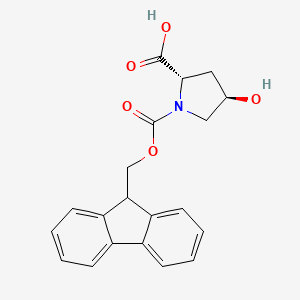
CAS · 88050-17-3
Product Overview
Fmoc-L-hydroxyproline is a high-purity amino-acids supplied for industrial and specialty chemical applications. Contact our team for specifications, packaging options and lead times.
Product Specifications
| Appearance | White powder |
|---|---|
| Purity (HPLC) | 98% min |
| TLC | 98% min |
| Specific Rotation [α]20/D (C=1 in MeOH) | -58° ± 3° |
| Melting Point | 186–196°C |
| Clarity of solution | 0.3 gram in 2ml DMF clear solution |
| Water Content (K.F.) | 1.0% max |
| Element analysis (C,H,N) | 5.0% max |
| Loss on drying (70°C, 2h) | 1.0% max |
| IR Spectrum | In accordance with the structure |
| Mass Spectrum | In accordance with the structure |
| NMR Spectrum | In accordance with the structure |
Applications
Fmoc-L-hydroxyproline is primarily used as a protected amino acid in peptide synthesis, particularly in solid-phase peptide synthesis (SPPS). The Fmoc (9-fluorenylmethyloxycarbonyl) protecting group safeguards the amino functionality during multi-step synthesis, allowing selective deprotection and sequential coupling. It is applied in the preparation of collagen-like peptides, cyclic peptides, and other bioactive sequences where hydroxyproline contributes to structural stability and biological function. Additionally, Fmoc-L-hydroxyproline is used in research for designing therapeutic peptides, peptide-based biomaterials, and molecular probes.
Benefits
The benefits of Fmoc-L-hydroxyproline include its stability, solubility, and selective reactivity, which facilitate efficient and reproducible peptide synthesis. Hydroxyproline residues enhance peptide secondary structure, particularly in collagen-mimetic sequences, improving stability and biological activity. The Fmoc protection ensures compatibility with a wide range of synthetic conditions while preventing undesired side reactions. Its versatility allows incorporation into diverse peptide constructs, supporting drug discovery, biochemical studies, and biomaterial development.
Conclusion
Fmoc-L-hydroxyproline is a valuable intermediate for the synthesis of structurally stable and biologically active peptides. Its combination of Fmoc protection, hydroxyproline functionality, and chemical stability makes it essential for solid-phase peptide synthesis and advanced peptide research. By enabling efficient and precise incorporation of hydroxyproline residues, it continues to play a critical role in peptide-based therapeutics, biomaterials, and biochemical studies.
Previous
FMOC-TRP(ME)-OH丨CAS 1334509-86-2
Next