
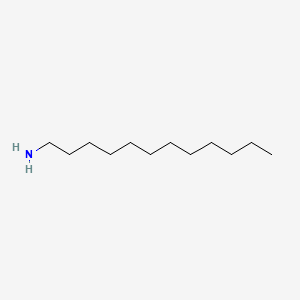
CAS · 124-22-1
Product Overview
Dodecanamine is a high-purity surfactants supplied for industrial and specialty chemical applications. Contact our team for specifications, packaging options and lead times.
Product Specifications
| Appearance | White solid |
|---|---|
| Primary amine content | 98% min |
| Color (APHA) | 40 max |
| Total amine value (mg KOH/g) | 295-306 |
| Partial amine value (mg KOH/g) | 5 max |
| Water | 0.3% max |
| Iodine value (g I₂/100g) | 1 max |
| Freezing point | 20-29 °C |
Applications
Dodecanamine is primarily used as an intermediate in the production of cationic surfactants, emulsifiers, and flotation agents. In water treatment and mineral processing, it functions as a collector in flotation systems, especially for silica and phosphate ores. In the agrochemical industry, it is utilized in the synthesis of herbicide and pesticide intermediates, where its long alkyl chain enhances surface activity and bioavailability. The compound is also applied in the production of corrosion inhibitors for oilfield chemicals, metalworking fluids, and industrial water systems, forming protective films on metal surfaces. In personal care and household products, derivatives of dodecanamine are used in fabric softeners, disinfectants, and conditioning agents due to their antimicrobial and antistatic properties. Additionally, it serves as a building block in the manufacture of quaternary ammonium compounds, lubricating oil additives, asphalt emulsifiers, and epoxy curing agents. Its compatibility with acid neutralization reactions also makes it suitable for producing amine salts used in various specialty formulations.
Benefits
One of the key benefits of Dodecanamine lies in its balanced hydrophobic–hydrophilic structure, enabling excellent surface activity and adsorption performance. The long C12 alkyl chain provides strong interaction with nonpolar surfaces, while the primary amine group allows easy chemical modification, salt formation, or quaternization. This dual functionality supports versatile formulation design across multiple industries. The compound demonstrates good thermal stability and chemical reactivity, making it suitable for large-scale industrial processing. Its effectiveness at relatively low concentrations contributes to cost-efficient formulations, particularly in flotation and corrosion inhibition applications. Furthermore, derivatives of dodecanamine often exhibit strong antimicrobial and antistatic performance, adding functional value in cleaning and textile treatments. From a manufacturing perspective, it integrates well into standard amination and surfactant production processes, allowing scalable and consistent production. Its availability in high-purity grades also supports quality control in regulated sectors such as agrochemicals and oilfield chemicals.
Conclusion
Dodecanamine is a versatile and industrially significant primary amine widely applied in surfactants, flotation agents, corrosion inhibitors, agrochemical intermediates, and specialty formulations. Its amphiphilic structure, chemical reactivity, and surface-active properties provide both technical efficiency and economic value. With broad compatibility across chemical processes and end-use industries, Dodecanamine remains an essential intermediate in modern industrial chemistry.
Previous
1-Bromo-3-chloro-5,5-dimethylhydantoin丨CAS 16079-88-2
Next