
Disodium 4,5-dihydro-4,5-dioxo-1H-pyrrolo(2,3-f)quinoline-2,7,9-tricarboxylate
CAS 122628-50-6
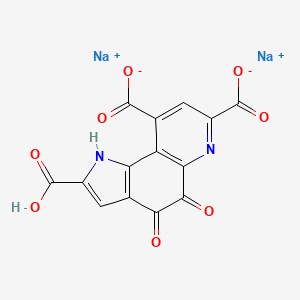
CAS · 122628-50-6
Product Overview
Disodium 4,5-dihydro-4,5-dioxo-1H-pyrrolo(2,3-f)quinoline-2,7,9-tricarboxylate is a high-purity food-additives supplied for industrial and specialty chemical applications. Contact our team for specifications, packaging options and lead times.
Product Specifications
| Grade | USP Grade |
|---|---|
| Appearance | Red or reddish-brown powder |
| Purity (HPLC) | 99.0% min |
| Assay (PQQ disodium salt, anhydrous basis) | 99.0% min |
| Identification (HPLC) | Conforms to the reference solution |
| Identification (UV) | A233 nm / A259 nm = 0.90 ± 0.09; A322 nm / A259 nm = 0.56 ± 0.03 |
| Water | 12.0% max |
| Heavy metals | 10 ppm max |
| Pb | 1 ppm max |
| As | 0.5 ppm max |
| Cd | 0.3 ppm max |
| Hg | 0.2 ppm max |
| Total Aerobic Microbial Count (TAMC) | 1,000 CFU/g max |
| Total Yeast & Mold Count (TYMC) | 100 CFU/g max |
| Enterobacteria | 100 CFU/g max |
| Escherichia coli | Negative / 10 g |
| Staphylococcus aureus | Negative / 10 g |
| Salmonella | Negative / 10 g |
Applications
Disodium 4,5-dihydro-4,5-dioxo-1H-pyrrolo(2,3-f)quinoline-2,7,9-tricarboxylate is a highly water-soluble derivative of a heterocyclic carboxylic acid, commonly used in biochemical research, analytical chemistry, and pharmaceutical studies. The compound is applied as a fluorescent or UV-active reagent in enzymatic assays, molecular biology experiments, and protein labeling techniques due to its stable chromophoric structure. In pharmaceutical development, it serves as a building block or intermediate in the synthesis of bioactive heterocyclic molecules and polycarboxylated drug candidates. Its solubility and ionic nature also make it suitable for use in aqueous buffer systems and as a standard or reference compound in analytical methods, including spectrophotometry and chromatography.
Benefits
This compound offers several advantages due to its solubility, chemical stability, and structural versatility. The disodium salt form ensures high water solubility and easy incorporation into aqueous systems, enhancing its applicability in biological assays and pharmaceutical formulations. Its tricarboxylate and heterocyclic moieties provide multiple reactive sites for derivatization, labeling, or conjugation reactions. The compound exhibits excellent thermal and photochemical stability, allowing reliable performance under various experimental and processing conditions. Additionally, it provides reproducible spectroscopic and analytical properties, making it a dependable tool in research and quality control.
Conclusion
Disodium 4,5-dihydro-4,5-dioxo-1H-pyrrolo(2,3-f)quinoline-2,7,9-tricarboxylate is a versatile heterocyclic derivative with broad applications in biochemical research, analytical chemistry, and pharmaceutical synthesis. Its benefits, including water solubility, chemical stability, and multifunctional reactivity, make it a valuable reagent and intermediate for laboratory and industrial use. Continued utilization of this compound supports advanced research, precise analytical measurements, and the development of novel bioactive molecules.
Previous
Sodium Carboxymethyl Cellulose丨CAS 9004-32-4
Next