
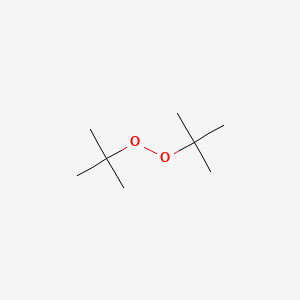
CAS · 110-05-4
Product Overview
Di-tert-butyl peroxide is a high-purity adhesives-sealants supplied for industrial and specialty chemical applications. Contact our team for specifications, packaging options and lead times.
Product Specifications
| Appearance: | Clear Liquid |
|---|---|
| Purity: | 98.5% min |
| Active Oxygen: | 10.8% min |
Applications
1. Polymer Industry
Free Radical Initiator: Widely used in the polymerization of monomers such as ethylene, styrene, and acrylates.
Crosslinking Agent: Helps in the crosslinking of polyethylene (PE), ethylene propylene diene monomer (EPDM), and other elastomers to enhance thermal, chemical, and mechanical stability.
2. Chemical Manufacturing
Organic Synthesis: Acts as a source of free radicals in oxidation, halogenation, and other radical-based reactions.
Fuel Additive: Sometimes used in the preparation of high-energy fuel formulations to enhance combustion efficiency.
3. Curing Agent
Used in curing unsaturated polyester resins (UPR) and thermoset plastics, providing structural rigidity and improved heat resistance.
4. Pharmaceutical and Agrochemical Intermediates
Plays a role in the synthesis of intermediates by enabling radical-induced transformations and initiating selective bond formations.
Benefits
High Thermal Stability: Compared to other peroxides, DTBP decomposes at higher temperatures (~150–170°C), offering precise control in thermal processes.
Controlled Radical Generation: Ideal for reactions requiring sustained radical flux at elevated temperatures.
Improved Polymer Properties: Enhances tensile strength, heat resistance, and durability in plastics and elastomers through effective crosslinking.
Versatile Compatibility: Compatible with a broad range of substrates in both industrial and laboratory settings.
Conclusion
Di-tert-butyl peroxide (CAS 110-05-4) is a crucial compound in modern industrial chemistry, primarily valued for its role as a free radical initiator and crosslinking agent. Its stability and performance at high temperatures make it ideal for polymer processing, chemical synthesis, and resin curing. While highly effective, its handling requires adherence to safety standards due to its reactive and flammable nature. As industries continue to demand advanced materials and precision polymer technologies, DTBP remains an essential tool in enabling these transformations.
Previous
2-Phenyl-2-propanol丨CAS 617-94-7
Next