
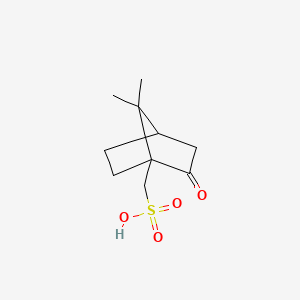
CAS · 5872-08-2
Product Overview
D-(+)-10-Camphorsulfonic acid丨CAS 5872-08-2 is a strong organic sulfonic acid that combines chirality and acidity within a rigid bicyclic camphor framework. It is widely used in organic synthesis, chiral resolution, asymmetric catalysis, and pharmaceutical manufacturing. Its unique structure offers stereochemical control in many transformations, making it a highly valuable chiral auxiliary and resolving agent.
Product Specifications
| Appearance | White crystal powder |
|---|---|
| Purity | 99.9% min |
| Specific Rotation | -2° to +2° |
| Loss on Drying | 1% max |
| Melting Point | 193°C to 202°C |
| Sulphate | 0.10% max |
| Iron | 10 ppm max |
| Water | 0.8% max |
Applications
1. Chiral Resolving Agent
CSA is frequently used to resolve racemic mixtures of basic or amine-containing compounds by forming diastereomeric salts, which can be separated based on differing physical properties (e.g., solubility, crystallization):
● Particularly useful in resolving chiral amines, alkaloids, and pharmaceutical intermediates
● Enables access to enantiomerically pure compounds critical for drug development
2. Chiral Catalyst and Auxiliary
CSA can serve as a chiral proton source or chiral co-catalyst in asymmetric synthesis, especially in:
● Asymmetric reductions
● Asymmetric epoxidations
● Chiral Brønsted acid catalysis
In these roles, CSA helps influence the stereochemical outcome of a reaction by introducing chiral induction.
3. Acid Catalyst in Organic Synthesis
Due to its strong acidity and good solubility, CSA is often used as a protonic acid catalyst for:
● Acetalization and deacetalization
● Esterifications
● Rearrangement reactions (e.g., Wagner–Meerwein)
● Cyclizations and condensations in carbohydrate and alkaloid chemistry
D-(+)-10-Camphorsulfonic acid丨CAS 5872-08-2 offers a safer and more selective alternative to inorganic acids like sulfuric or hydrochloric acid.
4. Synthesis of Camphorsulfonyl Chloride
CSA is the precursor to camphorsulfonyl chloride, which is used in:
● Sulfonylation of amines or alcohols
● Creating chiral sulfonamides or sulfonate esters
This derivative retains the chirality of CSA and adds versatility for further transformations.
5. Pharmaceutical and Fine Chemical Manufacturing
CSA finds wide application as an intermediate or reagent in:
● Active pharmaceutical ingredient (API) synthesis
● Peptide and oligonucleotide synthesis
● Stabilizing chiral drug substances via salt formation
Its low toxicity, ease of handling, and regulatory acceptance make it suitable for industrial-scale operations.
Benefits
1. Chirality and Stereoselectivity
● CSA provides a chiral environment that helps direct the formation of specific enantiomers in asymmetric synthesis.
● Especially useful in pharmaceutical chemistry, where enantiopurity is crucial for efficacy and safety.
2. Strong, Non-Oxidizing Acid
● As a strong Brønsted acid, CSA can catalyze a wide range of organic reactions.
● Unlike mineral acids, CSA is non-oxidizing, which reduces side reactions and decomposition.
3. Solid-State Stability and Solubility
● Crystalline and stable at room temperature
● Soluble in a range of solvents, allowing flexible use in aqueous and organic systems
4. Low Toxicity and Environmental Compatibility
● CSA is relatively non-toxic compared to other strong acids and is often considered more environmentally friendly.
● It is non-corrosive to metals, reducing equipment damage and improving lab and industrial safety.
5. Versatile Derivatization
● CSA can be easily converted into sulfonyl chlorides, esters, and salts, enhancing its utility in synthesis.
● Forms stable salts with alkaloids and amines, which can also improve drug solubility and bioavailability.
Conclusion
D-(+)-10-Camphorsulfonic acid丨CAS 5872-08-2 is a highly valuable reagent in stereoselective organic chemistry, known for its strong acidity, chirality, and versatility. Widely used in chiral resolution, asymmetric catalysis, acid catalysis, and pharmaceutical synthesis, CSA plays a crucial role in both research laboratories and industrial production. Its combination of stereochemical control, chemical stability, and broad reactivity makes it a preferred tool in the toolkit of modern synthetic and medicinal chemists.
Previous
1-Cyanonaphthalene丨CAS 86-53-3
Next