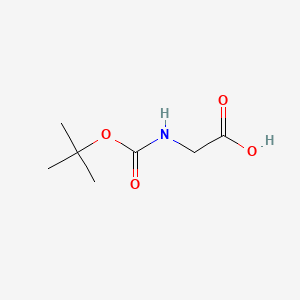
CAS · 4530-20-5
Product Overview
Boc-Glycine is a high-purity amino-acids supplied for industrial and specialty chemical applications. Contact our team for specifications, packaging options and lead times.
Product Specifications
| Appearance: | White fine crystals |
|---|---|
| Assay: | 99.0% min |
| Purity: | 99.0% min |
| Water (KF): | 1.0% max |
| Loss on drying: | 1.0% max |
| Free amino acid: | 0.5% max |
Applications
1. Peptide Synthesis
Boc-Glycine is primarily used as a building block in solid-phase and solution-phase peptide synthesis.
The Boc protecting group shields the amino group of glycine during peptide chain assembly, preventing unwanted side reactions.
After coupling, the Boc group can be selectively removed under acidic conditions to allow further peptide elongation.
Used in the synthesis of dipeptides, tripeptides, and longer peptides for research and pharmaceutical development.
2. Pharmaceutical and Medicinal Chemistry
Intermediate in the synthesis of peptide-based drugs and bioactive peptides.
Used in the development of enzyme inhibitors, receptor agonists, and antagonists.
Facilitates the creation of custom peptides for research in cancer, metabolic disorders, and infectious diseases.
3. Chemical Research and Organic Synthesis
Boc-Glycine serves as a protected amino acid reagent in various organic synthesis protocols.
Employed in the preparation of amino acid derivatives, peptidomimetics, and other complex molecules.
Enables site-selective functionalization in multistep synthetic routes.
4. Biotechnology and Molecular Biology
Utilized in custom peptide synthesis services for research in protein-protein interactions, antibody production, and diagnostics.
Important for producing fluorescent or labeled peptides used in molecular probes.
Benefits
1. Excellent Antifungal and Antibacterial Properties
Propionic acid inhibits the growth of molds and certain bacteria, making it highly effective in food preservation and feed hygiene.
This contributes to longer shelf life, reduced spoilage, and improved food safety.
2. Improves Feed Efficiency and Animal Performance
By preventing mold in feed, it helps retain nutrient content, promoting better digestion and animal weight gain.
It reduces the need for antibiotics in livestock, supporting antibiotic-free farming initiatives.
3. Cost-Effective and Versatile
Propionic acid is relatively low-cost compared to other preservatives.
It has a wide range of applications across different sectors, providing economic efficiency in supply chains.
4. Environmental and Regulatory Compliance
As a biodegradable and naturally occurring acid, it aligns with environmental standards and sustainable practices.
Widely approved for use in food and feed, ensuring regulatory ease in global trade.
5. Industrial Utility
Its role as a chemical intermediate makes it essential for the production of value-added chemicals and materials.
Offers good miscibility with water and organic solvents, enhancing its usability in formulations.
6. Shelf-life Extension Without Compromising Quality
In bakery and dairy products, it does not alter the flavor or texture significantly, preserving consumer experience while ensuring microbial safety.
Conclusion
Propionic acid (CAS 79-09-4) is a valuable chemical with multifaceted applications in food safety, agriculture, pharmaceuticals, cosmetics, and chemical synthesis. Its strong antimicrobial properties, cost efficiency, and compatibility with regulatory frameworks make it a crucial component in both commercial and industrial products. Whether it's extending the shelf life of bread, enhancing the digestibility of animal feed, or serving as a precursor in pharmaceuticals, propionic acid plays a vital role in modern science and industry.
Previous
Fmoc-N-methyltrityl-L-lysine丨CAS 167393-62-6
Next