
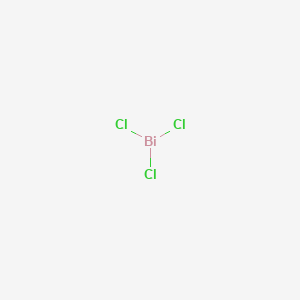
CAS · 7787-60-2
Product Overview
Bismuth trichloride丨CAS 7787-60-2 is an inorganic compound and a key member of the group 15 metal halides. It is used in organic synthesis, catalysis, material science, and has growing relevance in green chemistry due to the low toxicity of bismuth compared to other heavy metals like lead or mercury.
Bismuth-based compounds are increasingly favored in research and industry for their environmental friendliness, low bioaccumulation, and unique Lewis acidic properties.
Product Specifications
| Grade | AR Grade |
|---|---|
| Assay | 98.0% min |
| Hydrochloric insolubles | 0.1% max |
| NO3 | 0.02% max |
| SO4 | 0.01% max |
| Fe | 0.005% max |
| Cu | 0.005% max |
| Pb | 0.015% max |
| As | 0.001% max |
| Alkalies and alkaline earths | 0.1% max |
Applications
1. Catalyst in Organic Synthesis
Bismuth trichloride serves as an efficient Lewis acid catalyst for a wide range of organic reactions:
a. Friedel–Crafts Reactions
● Catalyzes acylation and alkylation of aromatic compounds.
● Preferred over aluminum chloride due to milder reaction conditions and reduced toxicity.
b. Aldol and Mannich Reactions
● Promotes carbon–carbon bond formation, making it useful in pharmaceutical and fine chemical synthesis.
c. Michael Additions and Cyclizations
● BiCl₃ is effective in promoting nucleophilic additions and ring-closure reactions, offering high selectivity and yield.
d. Protection/Deprotection of Functional Groups
● Used in acetalization, esterification, and deprotection of ketals or acetals.
2. Precursor in Material Science
● Bismuth trichloride丨CAS 7787-60-2 is used as a precursor for the preparation of bismuth-based functional materials, including:
Bismuth oxide (Bi₂O₃) for use in optics, electronics, and catalysts
Superconducting ceramics like Bi-Sr-Ca-Cu-O (BSCCO)
Photocatalysts and sensors for environmental and energy applications
3. Synthesis of Nanomaterials
● BiCl₃ is a starting material for preparing bismuth-based nanoparticles.
● These nanoparticles are investigated for antibacterial, catalytic, and photovoltaic applications.
4. Analytical Chemistry and Reagents
● BiCl₃ is employed in gravimetric and colorimetric analyses.
● Forms complexes with organic ligands, aiding in trace metal detection or separation processes.
5. Medicinal Chemistry and Pharmaceuticals
● Bismuth salts have long-standing use in treating gastrointestinal disorders.
● Although BiCl₃ itself is not directly used pharmaceutically due to hydrolysis, it serves as a precursor to bismuth-based medicinal compounds, such as:
Bismuth subsalicylate (used in antacids and anti-diarrheal medications)
Bismuth subcitrate, used in Helicobacter pylori eradication
6. Electronics and Semiconductors
● Utilized in research for bismuth-containing semiconductors and thermoelectric materials.
● Potential role in lead-free solders and bismuth-based dielectric materials.
Benefits
1. Low Toxicity
● Bismuth is one of the least toxic heavy metals, making its compounds environmentally and biologically safer.
● BiCl₃ is often preferred over more hazardous chlorides such as SnCl₄, AlCl₃, or FeCl₃ in laboratory and industrial use.
2. Mild and Selective Catalysis
● Functions under mild conditions, with high chemoselectivity.
● Compatible with various functional groups, enabling cleaner reactions with fewer byproducts.
3. Versatility
● Serves as a building block for other bismuth compounds, including halides, oxides, and organobismuth compounds.
● Applicable across organics, materials, and coordination chemistry.
4. Eco-Friendly Chemistry
● BiCl₃ plays a key role in green synthetic strategies, aligned with the goals of sustainable and safer chemical processes.
● Its catalytic applications often allow reduced waste and solvent-free conditions.
Conclusion
A concise summary and suitability assessment for this product is available on request. Contact our team to discuss whether it fits your process and quality requirements.