
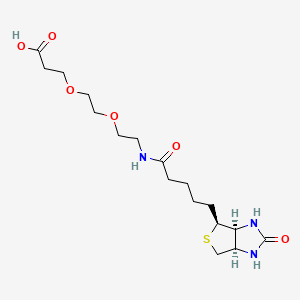
CAS · 1365655-89-5
Product Overview
Biotin-PEG2-Acid is a high-purity polyethylene-glycol supplied for industrial and specialty chemical applications. Contact our team for specifications, packaging options and lead times.
Product Specifications
| Appearance | Transparent and oil free liquid |
|---|---|
| Assay | 95% min |
Applications
Biotin-PEG2-Acid is a widely used linker molecule in bioconjugation, molecular labeling, and chemical biology. The compound combines biotin, which has a strong affinity for streptavidin and avidin proteins, with a short PEG2 (polyethylene glycol) spacer terminating in a carboxylic acid group, allowing for covalent attachment to biomolecules. It is commonly applied in the preparation of biotinylated peptides, proteins, antibodies, nucleic acids, and small molecules for use in affinity purification, ELISA assays, western blotting, and immunodetection. The PEG2 spacer reduces steric hindrance and improves solubility, enhancing the accessibility of the biotin tag for protein binding. Additionally, it is used in labeling for cell imaging, drug delivery research, and the development of biotin-streptavidin based biosensors, facilitating both in vitro and in vivo studies where targeted binding or immobilization is required.
Benefits
Biotin-PEG2-Acid offers several advantages that make it highly valuable in research and development. Its strong biotin-streptavidin affinity ensures highly specific and stable binding in assays and purification workflows. The PEG2 spacer provides flexibility and hydrophilicity, reducing steric hindrance and non-specific interactions, which is critical when labeling large biomolecules or designing multi-component conjugates. The carboxylic acid functional group allows versatile conjugation through amide bond formation or esterification, enabling attachment to a wide range of primary amine-containing molecules. Its small size relative to longer PEG linkers minimizes potential interference with biological activity while still improving solubility and molecular accessibility. Overall, it provides predictable, efficient, and reproducible bioconjugation, supporting high-quality assay development, imaging, and targeted molecule design.
Conclusion
Biotin-PEG2-Acid is a versatile and reliable bioconjugation reagent that enables efficient labeling and functionalization of peptides, proteins, nucleic acids, and small molecules. Its combination of a biotin moiety for strong affinity interactions, a short PEG2 spacer for solubility and flexibility, and a carboxylic acid group for covalent attachment makes it ideal for molecular labeling, affinity purification, biosensor development, and imaging applications. By improving accessibility, reducing steric hindrance, and providing stable, reproducible conjugation, Biotin-PEG2-Acid supports a wide range of research, diagnostic, and therapeutic applications in chemical biology and biotechnology.
Previous
Nonaethylene Glycol Monomethyl Ether丨CAS 6048-68-6
Next
14-(((Tert-butoxy)carbonyl)amino)-3,6,9,12-tetraoxatetradecanoic Acid丨CAS 876345-13-0