
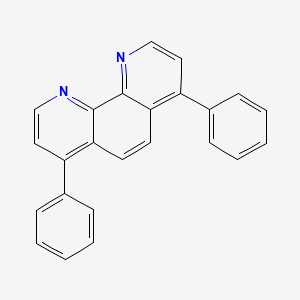
CAS · 1662-01-7
Product Overview
Bathophenanthroline is a high-purity solar-energy-materials supplied for industrial and specialty chemical applications. Contact our team for specifications, packaging options and lead times.
Product Specifications
| Appearance: | Pale yellow solid |
|---|---|
| Purity(HPLC): | 99.0% min. |
| HNMR: | Conforms |
Applications
1. Colorimetric Determination of Iron(II)
One of the most prominent uses of bathophenanthroline is in the colorimetric determination of Fe²⁺. It forms a deep red complex with Fe²⁺, allowing sensitive and selective detection.
Assay principle: The bathophenanthroline-Fe²⁺ complex absorbs strongly at ~535 nm.
Applications include:
Trace iron analysis in biological samples (blood serum, tissues)
Food and water testing
Pharmaceutical quality control
Its sensitivity is higher than other iron chelators like 1,10-phenanthroline, making it ideal for ultra-trace analysis.
2. Ligand in Coordination Chemistry
Bathophenanthroline is a versatile ligand forming stable coordination complexes with a wide variety of metals:
Transition metals (Fe, Ru, Co, Cu, Ni, Zn)
Lanthanides
These complexes are used in:
Homogeneous catalysis
Coordination polymer synthesis
Crystallography and structure elucidation
Its planar, aromatic structure provides both π-acceptor and σ-donor properties, enabling diverse coordination modes.
3. Fluorescent and Luminescent Probes
Metal-bathophenanthroline complexes exhibit strong luminescence and are used in:
Fluorescent probes for metal ions (especially Fe²⁺)
Sensitizers in photochemical reactions
Dyes in optoelectronic and OLED research
They are useful in designing molecular sensors, bioimaging agents, and photoredox catalysts.
4. Molecular Recognition and Sensing
Due to its strong metal-binding ability and high selectivity for Fe²⁺, bathophenanthroline is used in the design of:
Chemical sensors for redox-active metal ions
Biochemical assays to track iron concentrations in biological systems
Environmental monitoring devices for water quality assessment
Its chromogenic response allows for easy readouts even with minimal instrumentation.
5. Photochemistry and Photophysics
Bathophenanthroline complexes are studied for their photoactive properties, including:
Electron transfer processes
Energy transfer in supramolecular systems
Light-activated catalysis
These features make bathophenanthroline a key component in:
Photocatalytic water splitting
Artificial photosynthesis research
Light-driven redox cycles
6. Organic Electronics and OLED Materials
Some bathophenanthroline derivatives and their metal complexes are explored for their roles in:
Hole or electron transport materials
Luminescent dyes for organic light-emitting diodes (OLEDs)
Charge recombination centers in photovoltaic devices
Their rigid structure and redox stability contribute to performance enhancement in electronic materials.
7. Supramolecular Chemistry
Bathophenanthroline is used in self-assembly systems due to its rigid, planar structure and ability to coordinate metals in predictable geometries:
Metal–organic frameworks (MOFs)
Supramolecular coordination complexes
Host–guest systems
Such assemblies are valuable in catalysis, drug delivery, and material design.
Benefits
✅ High Sensitivity and Selectivity
Offers superior sensitivity for Fe²⁺ detection, even at micromolar or nanomolar concentrations.
Highly selective over Fe³⁺, minimizing false positives in mixed samples.
✅ Strong Metal-Ligand Affinity
Forms highly stable complexes with transition metals, enabling long-term use and consistent performance.
✅ Photophysical Versatility
Exhibits strong absorption and fluorescence when bound to metals, useful in spectroscopy, imaging, and sensors.
✅ Robust Structure
Chemically stable under a range of pH and temperature conditions.
Allows usage in harsh analytical or environmental conditions.
✅ Synthetic Flexibility
Can be further functionalized to tune solubility, coordination behavior, or spectroscopic properties.
✅ Colorimetric Detection Simplicity
Requires minimal instrumentation (UV-Vis spectrometer or even visual observation) for effective Fe²⁺ detection.
Conclusion
Bathophenanthroline (CAS 1662-01-7) is a powerful chelating agent and photofunctional ligand, known especially for its Fe²⁺ colorimetric detection and wide applications in coordination chemistry, sensing, luminescent materials, and catalysis. With strong metal affinity and useful optical properties, it plays a significant role in both fundamental research and industrial applications ranging from analytical chemistry to advanced materials development.
Previous
N,N-Bis(1-naphthalenyl)-N,N-bisphenyl-(1,1-biphenyl)-4,4-diamine丨CAS 123847-85-8
Next