
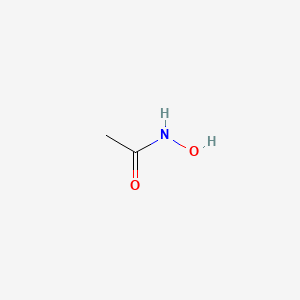
CAS · 546-88-3
Product Overview
Acetohydroxamic acid is a high-purity pharmaceutical-intermediates supplied for industrial and specialty chemical applications. Contact our team for specifications, packaging options and lead times.
Product Specifications
| Appearance | White crystal or crystalline powder |
|---|---|
| Assay | 98.0% |
| Melting point | 88.0 – 92.0 °C |
| Acidity (pH) | 3 – 6 |
| Identification (1) | Positive reaction |
| Identification (2) | Infrared meets requirements |
| Chloride | 0.02% max |
| Iron salt | 0.0005% max |
| Loss on drying | 1.0% max |
| Ignition residue | 0.1% max |
| Heavy metals | 10 ppm max |
Applications
Acetohydroxamic acid is a key compound in organic chemistry, particularly in the synthesis of metal chelating agents, pharmaceuticals, and agrochemicals. It is commonly used in the development of drugs that inhibit metalloproteases, which are enzymes involved in various disease processes, including cancer and arthritis. Acetohydroxamic acid's chelating properties make it useful for designing metal-based therapies, where it helps modulate the activity of essential metal ions in biological systems. In agriculture, acetohydroxamic acid is used as a pesticide and herbicide due to its ability to inhibit certain enzymes in plants, thereby preventing growth. Additionally, it finds use in the preparation of compounds that treat diseases related to iron overload, as it can bind to excess iron and prevent damage to tissues. Its applications extend to the synthesis of other useful chemicals and intermediates, where its hydroxamic acid group acts as a reactive functional group in further chemical reactions.
Benefits
The main benefits of acetohydroxamic acid stem from its ability to chelate metal ions, making it an effective agent in both medicinal and agricultural applications. In medicine, acetohydroxamic acid acts as a potent inhibitor of metalloproteases, offering therapeutic benefits in the treatment of diseases such as cancer, rheumatoid arthritis, and other conditions where metal ions play a crucial role in disease progression. Its ability to chelate metal ions also aids in the treatment of disorders like hemochromatosis, where excess iron accumulates in the body, causing tissue damage. In the agricultural sector, acetohydroxamic acid helps control the growth of certain unwanted plants and pests, offering a way to regulate plant growth and manage infestations. Its ability to bind and control metal ions allows for its use in various industrial and research applications, offering versatility and reactivity in chemical synthesis and therapeutic development.
Conclusion
Acetohydroxamic acid (CAS 546-88-3) is a highly versatile compound with significant applications in medicine, agriculture, and chemical synthesis. Its metal-chelating properties make it an important tool in the development of therapies for diseases involving metal ion dysregulation, such as cancer and iron overload disorders. In agriculture, it is used as a pesticide and herbicide, contributing to crop management and pest control. Additionally, its reactivity in organic synthesis provides a valuable functional group for designing other bioactive molecules and industrial chemicals. Overall, acetohydroxamic acid's ability to interact with metal ions and its diverse applications make it an essential compound in both scientific research and practical industries.
Previous
2-Bromo-9-phenyl-1,10-phenanthroline丨CAS 2042493-16-1
Next