
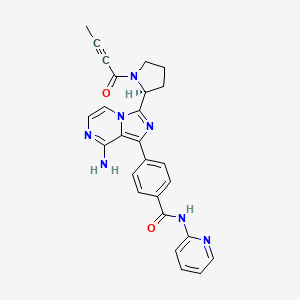
CAS · 1420477-60-6
Product Overview
Acalabrutinib is a high-purity a-api supplied for industrial and specialty chemical applications. Contact our team for specifications, packaging options and lead times.
Product Specifications
| Appearance | White to off-white powder |
|---|---|
| Assay (on anhydrous basis) | 98.0% to 102.0% |
| Solubility | pH-dependent solubility in aqueous media; freely soluble in dimethyl sulfoxide |
| Identification | IR: Absorption spectrum concordant with test standard HPLC: Spectrum concordant with standard substance |
| Polymorphic form | Form I |
| Water | 1.0% max |
| Residue on ignition | 0.1% max |
| Heavy metals | 20 ppm max |
| Particle size distribution (D90) | 20 µm max |
| Enantiomer | 0.15% max |
| Related substances | Any other impurity: 0.1% max Total impurities: 1.0% max |
| Residual solvents | Dichloromethane: 0.06% max Ethanol: 0.5% max Acetone: 0.5% max Ethyl acetate: 0.5% max n-Heptane: 0.5% max |
| Microbial limit | Total aerobic microbial count: 1000 cfu/g max Total yeast and mold: 100 cfu/g max Escherichia coli: Absent/g |
Applications
Acalabrutinib is a highly selective Bruton's tyrosine kinase (BTK) inhibitor primarily used in the treatment of hematological malignancies. It has been developed as a targeted therapy for conditions such as mantle cell lymphoma (MCL), chronic lymphocytic leukemia (CLL), and small lymphocytic lymphoma (SLL). By irreversibly binding to BTK, a critical enzyme in B-cell receptor signaling, acalabrutinib disrupts pathways that drive malignant B-cell proliferation and survival. In clinical practice, it is often prescribed as a monotherapy or in combination with other agents, expanding its therapeutic scope. Beyond oncology, ongoing research is exploring its potential in autoimmune and inflammatory disorders, given BTK's role in regulating immune cell activity. Its selective inhibition profile makes it an important drug for advancing precision medicine strategies in hematology and immunology.
Benefits
The benefits of acalabrutinib lie in its high selectivity, efficacy, and improved tolerability compared to earlier BTK inhibitors. By specifically targeting BTK with minimal off-target activity, it reduces the risk of adverse effects commonly associated with broader kinase inhibitors. This enhances patient compliance and long-term treatment outcomes. Clinical studies have demonstrated its strong efficacy in controlling B-cell malignancies, with durable responses and favorable safety profiles. Furthermore, its potential to be combined with other targeted therapies or immunotherapies broadens its utility in personalized treatment regimens. Its oral bioavailability and convenient dosing also make it accessible for long-term management of chronic conditions. Overall, acalabrutinib exemplifies modern advances in precision oncology by offering targeted and effective disease control with improved patient quality of life.
Conclusion
Acalabrutinib (CAS 1420477-60-6) is an important BTK inhibitor that has transformed the management of B-cell malignancies and is under investigation for broader applications in immunology. Its mechanism of action, high selectivity, and clinical efficacy make it a vital component of targeted cancer therapy. With benefits including durable responses, better tolerability, and suitability for combination regimens, acalabrutinib represents a significant advancement in precision medicine. As research continues, it is likely to expand its role in treating both hematologic cancers and immune-related conditions, further solidifying its importance in modern therapeutics.
Previous
Next