
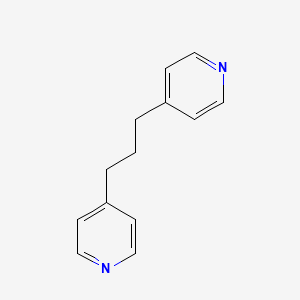
CAS · 17252-51-6
Product Overview
4,4-Trimethylenedipyridine is a high-purity pharmaceutical-intermediates supplied for industrial and specialty chemical applications. Contact our team for specifications, packaging options and lead times.
Product Specifications
| Appearance | White solid |
|---|---|
| Purity (GC) | 99% min |
| Identification | 1H NMR |
Applications
4,4-Trimethylenedipyridine (CAS 17252-51-6) is an important organic intermediate widely used in coordination chemistry, pharmaceuticals, and materials science. It acts as a bidentate ligand in the formation of metal complexes, which are valuable in catalysis, molecular recognition, and supramolecular chemistry. In pharmaceutical research, it serves as a building block for the synthesis of bioactive compounds, heterocyclic derivatives, and potential therapeutic agents targeting various biological pathways. Additionally, 4,4-trimethylenedipyridine is employed in polymer and materials chemistry as a crosslinking agent or structural unit in the preparation of functionalized polymers, ionic liquids, and advanced coordination networks, where the pyridine groups facilitate electron-donating interactions and structural stability.
Benefits
The benefits of 4,4-trimethylenedipyridine stem from its rigid, symmetrical structure and dual pyridine functionality. The two pyridine rings separated by a flexible trimethylene linker provide strong chelation ability and versatile binding sites for metal ions, enabling the formation of stable and tunable complexes. Its chemical stability, solubility in common organic solvents, and compatibility with various reaction conditions make it practical for laboratory synthesis and industrial applications. The molecule's bifunctional nature allows for selective modification, derivatization, or polymer incorporation, enhancing its utility in both synthetic and materials chemistry.
Conclusion
4,4-Trimethylenedipyridine is a versatile bidentate intermediate with broad applications in coordination chemistry, pharmaceuticals, and functional materials. Its symmetrical structure, chemical stability, and dual pyridine groups facilitate the design of metal complexes, bioactive molecules, and advanced polymers. By enabling precise molecular engineering and complex synthesis, it remains a valuable compound in research and industrial chemistry.
Previous
2-bromo-2-ethyl Butanoic Acid丨CAS 5456-23-5
Next