
(4-(N,N-Dimethylamino)phenyl)di-tert-butyl phosphine
CAS 932710-63-9
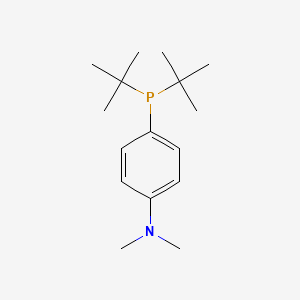
CAS · 932710-63-9
Product Overview
(4-(N,N-Dimethylamino)phenyl)di-tert-butyl phosphine is a high-purity oled-materials supplied for industrial and specialty chemical applications. Contact our team for specifications, packaging options and lead times.
Product Specifications
| Property | Specification |
|---|---|
| Appearance | White to off-white solid |
| Assay (GC) | 98.0% min |
| NMR | H-NMR, P-NMR |
Applications
1. Ligand in Transition Metal Catalysis
(4-(N,N-Dimethylamino)phenyl)di-tert-butyl phosphine丨CAS 932710-63-9 is primarily used as a ligand in homogeneous catalysis, particularly with palladium, nickel, and copper complexes.
● Cross-coupling reactions: It significantly enhances the efficiency of Suzuki–Miyaura, Stille, Heck, and Buchwald–Hartwig aminations, especially with challenging aryl chlorides or hindered substrates.
● C–N and C–C bond formation: It supports high turnover numbers and rates due to its strong σ-donating properties, making it suitable for industrial and pharmaceutical synthesis.
2. Pharmaceutical Intermediate Synthesis
Due to its role in enabling efficient C–X (X = N, O, C) bond formation, it is often employed in drug discovery and API manufacturing pipelines.
● Steric and electronic tuning: The ligand's bulky tert-butyl groups and electron-rich nature help stabilize reactive intermediates and reduce side reactions, especially with electron-deficient aryl halides.
3. Material Science and Organic Electronics
In the synthesis of organic semiconductors or OLED materials, this ligand aids in facilitating C–C coupling processes, critical for building conjugated backbones.
● Synthesis of π-conjugated molecules: Its use ensures high regioselectivity and better yields when synthesizing complex organic materials.
Benefits
1. High Electron Donating Capacity
The N,N-dimethylamino group and bulky tert-butyl groups make this phosphine highly electron-rich, which improves the oxidative addition step in catalytic cycles.
2. Steric Bulk Enhances Selectivity
The large size of the tert-butyl groups prevents undesired side reactions and favors monoligated metal complexes, often leading to better regio- and chemoselectivity.
3. Stability and Handling
Unlike some sensitive phosphines, (4-(N,N-Dimethylamino)phenyl)di-tert-butylphosphine exhibits reasonable air and thermal stability, making it easier to handle in laboratory and industrial settings when stored properly.
4. Widely Cited in Catalysis Literature
(4-(N,N-Dimethylamino)phenyl)di-tert-butyl phosphine丨CAS 932710-63-9 has become a valuable tool in academic and industrial synthetic chemistry, especially where electron-rich, bulky phosphines are needed to unlock difficult transformations.
Previous
Next
Conclusion
A concise summary and suitability assessment for this product is available on request. Contact our team to discuss whether it fits your process and quality requirements.