
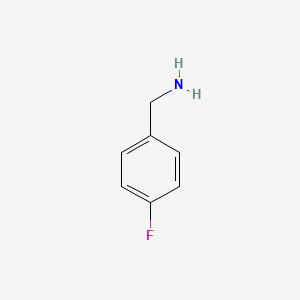
CAS · 140-75-0
Product Overview
4-Fluorobenzylamine is a high-purity pesticide-intermediate supplied for industrial and specialty chemical applications. Contact our team for specifications, packaging options and lead times.
Product Specifications
| Property | Specification |
|---|---|
| Appearance | Clear colorless to yellowish liquid |
| Purity (GC) | 98% min |
| Moisture | 0.5% max |
Applications
4-Fluorobenzylamine丨CAS 140-75-0 is an aromatic amine compound with a fluorine atom attached to the benzene ring at the para position. This compound is widely used as an intermediate in organic synthesis and has applications in pharmaceutical, material science, and chemical research.
1. Pharmaceutical and Medicinal Chemistry
● Intermediate for drug synthesis: 4-Fluorobenzylamine is a versatile intermediate used in the synthesis of pharmaceutical compounds, particularly in the development of neurological and cardiovascular agents.
● Prodrug formulations: It can be used in the development of prodrugs, where the functional group is used to enhance the solubility or bioavailability of the active drug molecule.
● Serotonergic agents: It serves as a key starting material in the synthesis of serotonin receptor ligands and selective serotonin reuptake inhibitors (SSRIs), which are used to treat depression, anxiety, and other mood disorders.
2. Organic Synthesis
● Building block for functionalized aromatic compounds: The fluorine substitution on the benzene ring can impart unique electronic properties, making 4-fluorobenzylamine useful in the creation of functionalized aromatic systems.
● Cross-coupling reactions: It can be used in Suzuki, Stille, and other coupling reactions, enabling the synthesis of more complex organic compounds.
● Substitution reactions: The amine group (-NH2) can act as a nucleophile in various substitution reactions, allowing for the attachment of additional functional groups.
3. Material Science
● Polymer synthesis: 4-Fluorobenzylamine丨CAS 140-75-0 can be utilized in the creation of fluorine-containing polymers that exhibit enhanced chemical stability and solubility in non-polar solvents.
● Fluorinated materials: Its incorporation into polymer backbones or coatings may lead to materials with specific hydrophobic or electronically conductive properties, which can be useful in the production of electronics or displays.
4. Chemical Research
● Reaction studies: Due to its distinct fluorine substituent, 4-fluorobenzylamine is often employed in research experiments to explore the effects of fluorine substitution on chemical reactivity, stability, and selectivity in organic reactions.
● Development of new synthetic methodologies: It is used in the exploration of new synthetic pathways for the formation of amine derivatives and other functionalized benzene compounds.
Benefits
1. High Reactivity and Versatility
● The amine group (-NH2) in 4-fluorobenzylamine is highly reactive, allowing it to participate in a range of nucleophilic substitution and coupling reactions to form diverse compounds.
● The fluorine atom contributes to its unique electronic properties, enhancing the compound's utility in organic synthesis and offering selective reactivity in reactions.
2. Pharmaceutical Potential
● As a building block for a variety of bioactive molecules, 4-fluorobenzylamine is of interest in drug discovery, especially for developing molecules targeting serotonergic systems.
● It could lead to the creation of novel antidepressant, anxiolytic, or neuroactive compounds with improved pharmacological profiles.
3. Improved Stability
● The fluorine atom in the para position provides enhanced stability and lipophilicity, making it useful in the development of fluorinated compounds that are more stable and resistant to metabolic breakdown.
4. Electronics and Material Enhancement
● Fluorine-containing compounds like 4-fluorobenzylamine can help develop fluorinated polymers or materials with hydrophobic, chemical resistance, and low surface energy, which can be applied in various electronic or coating applications.
5. Synthetic Efficiency
● The fluorine substituent can make the compound an excellent candidate for cross-coupling reactions and other synthetic methodologies, potentially leading to more efficient pathways for the synthesis of complex organic molecules.
Previous
Methyl Acetoacetate丨CAS 105-45-3
Next
Conclusion
A concise summary and suitability assessment for this product is available on request. Contact our team to discuss whether it fits your process and quality requirements.