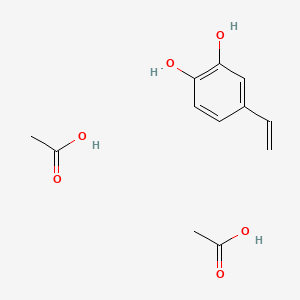
CAS · 57142-64-0
Product Overview
3,4-diacetoxystyrene is a high-purity pharmaceutical-intermediates supplied for industrial and specialty chemical applications. Contact our team for specifications, packaging options and lead times.
Product Specifications
| Appearance: | Light yellow solid or liquid |
|---|---|
| Purity: | 97% min |
Applications
1. Monomer for Polymer Synthesis
3,4-Diacetoxystyrene can be polymerized via radical polymerization to form functionalized polymers. Its acetoxy groups allow for post-polymerization modifications, such as deprotection to generate dihydroxy-functional polymers (e.g., polycatechols or phenolic resins).
2. Precursor to Catechol-Functionalized Compounds
Upon hydrolysis, the acetyl groups can be removed to yield 3,4-dihydroxystyrene, a catechol derivative. Catechols are important in surface chemistry (e.g., dopamine-inspired adhesives), metal-binding ligands, and bioactive materials.
3. Materials Science & Surface Coatings
The catechol derivatives obtained from 3,4-diacetoxystyrene are used in the development of bio-inspired adhesives, such as mussel-inspired coatings. These materials adhere well to metal, glass, and polymer surfaces.
4. Biomedical Applications
The compound and its derivatives are explored for biomedical coatings and drug delivery systems, where catechol moieties can be used for targeted binding and controlled release mechanisms.
5. Functional Cross-Linkers or Additives
The styrenic vinyl group can engage in crosslinking reactions with other vinyl monomers, allowing its use as a functional additive to tailor mechanical, thermal, or adhesive properties in copolymers.
Benefits
Dual Functionality: Offers both a polymerizable vinyl group and modifiable acetoxy groups.
Protecting Group Strategy: Acetyl groups serve as stable protecting groups for hydroxyls, allowing selective deprotection under mild conditions.
Versatility: Acts as a platform to synthesize catechol-containing polymers and small molecules.
Surface Reactivity: Catechol groups derived from this molecule exhibit strong adhesion and metal-binding properties.
Conclusion
3,4-Diacetoxystyrene is a multifunctional compound of significant value in polymer chemistry, materials science, and biomedical engineering. Its unique structure allows for controlled polymerization and subsequent conversion to catechol-functional materials, making it a useful intermediate for applications ranging from adhesives to biointerfaces. As functional material design evolves toward bioinspiration and sustainability, compounds like 3,4-diacetoxystyrene are likely to see expanded use in next-generation smart materials and coatings.
Previous
3,6-dichloropyridazine丨CAS 141-30-0
Next