
3-yridinecarboxylic acid, 6-chloro-2-methyl-, methyl ester
CAS 851759-19-8
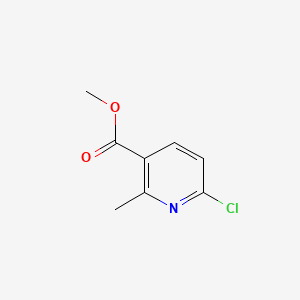
CAS · 851759-19-8
Product Overview
3-yridinecarboxylic acid, 6-chloro-2-methyl-, methyl ester is a high-purity pharmaceutical-intermediates supplied for industrial and specialty chemical applications. Contact our team for specifications, packaging options and lead times.
Product Specifications
| Appearance: | White crystal solid |
|---|---|
| Assay (by GC): | 98% min |
| Water: | 0.5% max |
Applications
3-Pyridinecarboxylic acid, 6-chloro-2-methyl-, methyl ester is a versatile heteroaromatic intermediate widely used in pharmaceutical and agrochemical synthesis. Its pyridine ring and ester functionality make it a key building block for the development of active pharmaceutical ingredients (APIs), including antiviral, antibacterial, and anti-inflammatory compounds. In medicinal chemistry, it serves as a precursor for heterocyclic scaffolds, enabling functionalization at both the ester and pyridine positions to optimize pharmacokinetic and pharmacodynamic properties. The chlorine substituent enhances reactivity for cross-coupling reactions such as Suzuki, Buchwald–Hartwig, or Stille reactions, allowing the introduction of diverse substituents. In agrochemical research, it is used in the synthesis of herbicides, fungicides, and insecticides, where the pyridine core and substituents improve bioactivity, stability, and metabolic resistance. The methyl ester group also allows for hydrolysis, amidation, or further functionalization to produce complex derivatives efficiently.
Benefits
The benefits of this compound derive from its multifunctional structure, chemical stability, and reactivity. The pyridine ring provides a stable heteroaromatic framework with electron-rich and electron-deficient sites, enabling selective chemical transformations. The 6-chloro substituent allows for halogen-mediated reactions, facilitating efficient cross-coupling and functionalization. The methyl ester group acts as a reactive site for hydrolysis or condensation reactions, offering flexibility in downstream synthesis. Its stability under standard laboratory conditions ensures reproducible reactions and long-term storage without significant degradation. Moreover, the compound's combination of pyridine, halogen, and ester functionalities allows chemists to create diverse chemical libraries, accelerating drug discovery and agrochemical development. Its compatibility with various solvents and reagents further enhances its versatility in synthetic applications.
Conclusion
3-Pyridinecarboxylic acid, 6-chloro-2-methyl-, methyl ester (CAS 851759-19-8) is a valuable heteroaromatic intermediate for pharmaceutical and agrochemical synthesis. Its pyridine core, chlorine substituent, and ester functionality provide high reactivity, chemical stability, and synthetic versatility. By enabling efficient construction of heterocyclic scaffolds, bioactive molecules, and functional derivatives, this compound supports innovation and efficiency in drug discovery, agrochemical development, and advanced organic synthesis.
Previous
5-amino-2,4-ditert-butylphenol丨CAS 873055-58-4
Next