
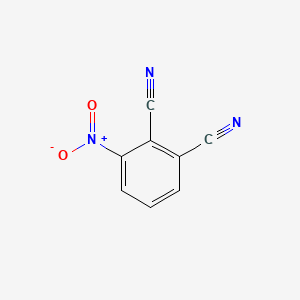
CAS · 51762-67-5
Product Overview
3-Nitrophthalonitrile is a high-purity pharmaceutical-intermediates supplied for industrial and specialty chemical applications. Contact our team for specifications, packaging options and lead times.
Product Specifications
| Appearance: | Off-white to pale yellow powder |
|---|---|
| Purity (HPLC): | 99.0% min |
| Melting point (MP): | 162~165℃ |
| Water: | 1.0% max |
| Loss on drying: | 1.0% max |
| Identification (HPLC): | Retention time of the principal peak in sample should match retention time of standard principal peak in HPLC |
Applications
3‑Nitrophthalonitrile is primarily used as a versatile synthetic intermediate in the preparation of functionalized phthalonitriles and downstream derivatives. Its most important application is as a precursor for phthalocyanines and related macrocycles-high‑performance dyes and pigments used in coatings, inks, photovoltaics, organic electronics and catalysts-where controlled substitution patterns on the phthalonitrile ring enable tuning of optical and electronic properties. It is also employed in medicinal‑ and agrochemical research as a building block for constructing heterocycles, tetrazoles, amidines and other nitrogen‑rich motifs through transformations of the nitrile groups. The nitro substituent provides an orthogonal handle for selective reduction to an aniline (for further acylation, sulfonylation, diazotization or coupling), or for displacement reactions to install heteroatoms or carbon fragments, making it useful in library synthesis and structure–activity relationship (SAR) studies. In materials chemistry, derivatives derived from 3‑nitrophthalonitrile are used to build conjugated small molecules and polymers with enhanced thermal stability and electron‑accepting character for organic semiconductors and charge‑transfer assemblies.
Benefits
The compound's value lies in the combination of two nitrile groups and a strategically placed nitro group on a compact aromatic scaffold. The dinitrile motif is a direct, convergent entry to phthalocyanine formation and to a wide set of heterocycles, while the nitro group is a robust, chemoselective functional handle that can be reduced or transformed without disturbing the nitriles. Electron‑withdrawing substituents (nitriles and nitro) increase the ring's susceptibility to nucleophilic aromatic substitution at activated positions, enabling selective introduction of tail groups under mild conditions. This synthetic flexibility allows chemists to tune solubility, electronic properties, and steric profile of final products for applications ranging from pigments to electronic materials. Additionally, products derived from this scaffold tend to display good thermal and oxidative stability-important for industrial pigments, high‑temperature polymers and device components-while the relatively small, symmetric core aids reproducible scale‑up and purification.
Conclusion
3‑Nitrophthalonitrile is a high‑utility intermediate that bridges fine‑chemical synthesis and advanced materials development. Its dual nitrile functionality combined with a modifiable nitro group provides multiple orthogonal transformation pathways, enabling rapid generation of phthalocyanines, heterocycles, and conjugated materials with controllable optical, electronic and thermal properties. For researchers and manufacturers aiming to design dyes, electronic materials, or nitrogen‑rich heterocycles, this compound offers a compact, reliable starting point that supports efficient diversification and property optimization.
Previous
1-(3,5-Dichlorophenyl)-2,2,2-trifluoroethan-1-one丨CAS 130336-16-2
Next