
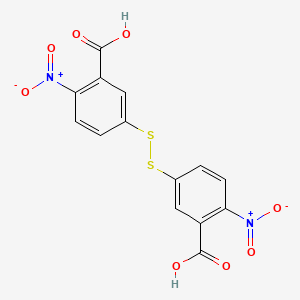
CAS · 69-78-3
Product Overview
3-Carboxy-4-nitrophenyl disulfide is a high-purity amino-acids supplied for industrial and specialty chemical applications. Contact our team for specifications, packaging options and lead times.
Product Specifications
| Appearance | Light yellow to yellow powder |
|---|---|
| Assay (T) | 98% min |
| Solubility (1% methanol) | Clear solution |
Applications
3-Carboxy-4-nitrophenyl disulfide is a sulfur-containing aromatic compound primarily used in biochemical and pharmaceutical research. It is often employed as a reagent for studying thiol–disulfide exchange reactions, which are critical in protein folding, redox biology, and enzymatic activity. The compound serves as a useful probe in analytical chemistry for quantifying free thiol groups in peptides and proteins, making it relevant for biochemical assays. In synthetic chemistry, it can act as an intermediate or functional reagent in the preparation of disulfide-containing molecules. Its applications extend to drug discovery, where it supports the development of compounds targeting oxidative stress and redox-regulated biological pathways.
Benefits
The benefits of 3-carboxy-4-nitrophenyl disulfide lie in its reactivity, specificity, and versatility in biochemical studies. Its strong chromophore allows easy spectrophotometric detection, simplifying analytical procedures and enabling high sensitivity in thiol quantification. The compound's ability to engage in controlled disulfide exchange reactions makes it a powerful tool for probing protein structure and function. Its stability and reproducibility enhance reliability in laboratory experiments, while its role in supporting redox biology research opens possibilities for advancing therapeutic development. By providing a straightforward means to investigate critical biochemical mechanisms, it strengthens both fundamental research and applied biomedical studies.
Conclusion
3-Carboxy-4-nitrophenyl disulfide (CAS 69-78-3) is a valuable research reagent with significant roles in protein chemistry, redox biology, and drug discovery. Its reliable reactivity and strong analytical signal make it particularly suited for thiol–disulfide studies, contributing to advances in understanding protein function and oxidative processes. With its broad research utility and dependable performance, it remains an important compound in biochemical and pharmaceutical investigations.
Previous
(S)-N-Boc-1-Naphthylalanine丨CAS 55447-00-2
Next