
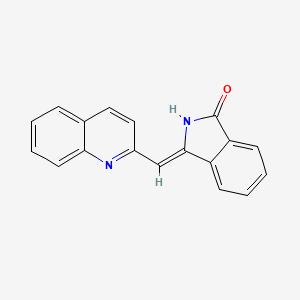
CAS · 13481-47-5
Product Overview
3-(2-Quinolylmethylene)phthalimidine is a high-purity dyes-pigments supplied for industrial and specialty chemical applications. Contact our team for specifications, packaging options and lead times.
Product Specifications
| Appearance: | Yellow powder |
|---|---|
| Purity: | 95% min |
Applications
3-(2-Quinolylmethylene)phthalimidine (CAS 13481-47-5) is a heterocyclic aromatic compound widely used as an intermediate and ligand in pharmaceutical, coordination chemistry, and materials science applications. It serves as a valuable building block in the synthesis of biologically active compounds, including antitumor, antimicrobial, and antiviral agents. In coordination chemistry, it functions as a chelating ligand, forming stable complexes with transition metals that exhibit interesting catalytic, luminescent, or magnetic properties. It is also explored in fluorescence and photophysical studies due to the conjugation between the quinoline and phthalimidine moieties, which enhances electronic delocalization and optical activity.
Benefits
The benefits of 3-(2-quinolylmethylene)phthalimidine stem from its multifunctional structure that integrates aromatic, imine, and heterocyclic elements. This design provides high reactivity, enabling diverse chemical modifications and complex formations. The conjugated quinoline system imparts strong fluorescence and electron-donating properties, making it suitable for optoelectronic and sensing applications. As a ligand, it stabilizes metal centers and promotes selective catalytic transformations. In pharmaceutical development, its heterocyclic framework contributes to favorable biological interactions and pharmacological potential. Its versatility, stability, and tunable properties make it an effective intermediate for research and industrial innovation.
Conclusion
3-(2-Quinolylmethylene)phthalimidine is a versatile heterocyclic compound with important applications in drug discovery, coordination chemistry, and materials science. Its conjugated structure and chelating capability offer both chemical and functional advantages, supporting the development of bioactive molecules, catalysts, and functional materials. By combining stability, reactivity, and optical potential, it continues to serve as a valuable tool in advanced chemical synthesis and research applications.
Previous
5-Amino-3-methyl-1-phenylpyrazole丨CAS 1131-18-6
Next