
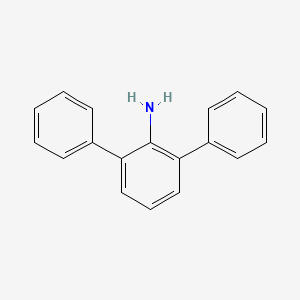
CAS · 87666-57-7
Product Overview
2,6-Diphenylaniline is a high-purity oled-materials supplied for industrial and specialty chemical applications. Contact our team for specifications, packaging options and lead times.
Product Specifications
| Appearance: | Off-white or white powder |
|---|---|
| Purity: | 99% min |
Applications
1. Organic Electronics and OLEDs
Widely used as a hole-transporting material (HTM) or intermediate in the design of:
OLEDs (Organic Light-Emitting Diodes)
Organic photovoltaic devices (OPVs)
Perovskite solar cells
Its planar and rigid structure promotes π-conjugation, aiding charge mobility.
2. Ligand and Intermediate in Coordination Chemistry
Serves as a building block for Schiff base ligands and coordination compounds used in:
Catalysis
Metal–organic frameworks (MOFs)
Sensors
3. High-Performance Polymers
Acts as a monomer or crosslinker in the synthesis of:
Polyimides
Aromatic polyamides
These materials are valued for thermal stability, chemical resistance, and mechanical strength in aerospace and electronics.
4. Pharmaceutical and Agrochemical Intermediate
Although not typically bioactive on its own, 2,6-diphenylaniline is used as an intermediate in the synthesis of:
Kinase inhibitors
Anti-inflammatory agents
Herbicides or fungicides
Benefits
1. Enhanced Thermal and Chemical Stability
Aromatic substitution at ortho-positions protects the amino group from oxidation and decomposition.
Makes it ideal for high-temperature applications like OLED devices and engineering plastics.
2. Rigidity and Planarity
The structural configuration leads to rigid molecular packing and extended π-conjugation, which improves:
Charge transport
Film-forming properties
Electronic interaction with semiconductors
3. Synthetic Versatility
The amino group allows for:
N-alkylation or acylation
Formation of azo compounds, imines, or amides
Phenyl groups can undergo further functionalization such as halogenation or cross-coupling.
4. Optoelectronic Tunability
Its electronic properties can be tuned by modifying the substituents on the phenyl rings, enabling tailored material design for specific optoelectronic applications.
Conclusion
2,6-Diphenylaniline (CAS 87666-57-7) is a multifunctional aromatic amine prized for its chemical stability, structural rigidity, and electronic properties. It finds significant use in organic electronic devices, high-performance polymers, and as a synthetic intermediate in pharmaceuticals and materials science. Its well-defined structure makes it a go-to scaffold in advanced material and ligand design.
Previous
(9-phenyl-9H-carbazol-4-yl)boronic Acid丨CAS 1370555-65-9
Next
5-(1,1-biphenyl-3-yl)-5,8-dihydroindolo2,3-ccarbazole丨CAS 2303611-62-1