
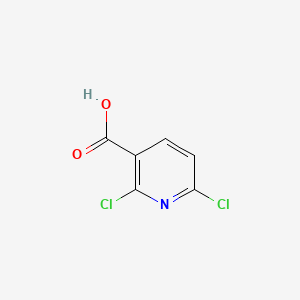
CAS · 38496-18-3
Product Overview
2,6-Dichloronicotinic acid is a high-purity pharmaceutical-intermediates supplied for industrial and specialty chemical applications. Contact our team for specifications, packaging options and lead times.
Product Specifications
| Item | Specification |
|---|---|
| Appearance | White to yellow solid |
| Water (KF) | 0.5% max |
| Single impurity (HPLC) | 1.0% max |
| Purity (HPLC) | 95% min |
Applications
2,6-Dichloronicotinic acid (CAS 38496-18-3) is a halogenated pyridinecarboxylic acid widely used as an intermediate in pharmaceuticals, agrochemicals, and fine chemical synthesis. Its dichloro-substituted pyridine ring, combined with the carboxylic acid functionality, makes it a versatile scaffold for building heterocyclic compounds, enzyme inhibitors, and receptor ligands. In medicinal chemistry, it is employed in the synthesis of drug candidates where halogenation improves metabolic stability and binding affinity. In agrochemicals, it serves as a precursor for herbicides, fungicides, and insecticides with enhanced potency and environmental resilience. It is also applied in material science and coordination chemistry, where its pyridine and carboxyl groups provide useful sites for metal-ligand interactions.
Benefits
The benefits of 2,6-dichloronicotinic acid lie in its dual reactivity and functional versatility. The chloro substituents are excellent leaving groups, enabling cross-coupling and substitution reactions to introduce diverse functional groups. The carboxylic acid group allows transformations such as esterification, amidation, or salt formation, expanding its synthetic utility. The pyridine ring contributes rigidity and electronic effects, enhancing biological activity and stability in derived compounds. These combined features make it a highly adaptable building block for efficient multi-step syntheses across pharmaceutical, agrochemical, and material chemistry applications.
Conclusion
In summary, 2,6-dichloronicotinic acid is a valuable intermediate with broad applications in pharmaceuticals, agrochemicals, and materials science. Its applications include drug precursor synthesis, crop-protection agent development, and coordination compound preparation, while its benefits come from reactive chloro substituents, versatile carboxyl chemistry, and biologically relevant pyridine scaffolding. As demand for halogenated heterocycles continues to rise, this compound remains an important tool in modern synthetic chemistry.
Previous
4,4-Butylidenebis(6-tert-butyl-3-methylphenol)丨CAS 85-60-9
Next