
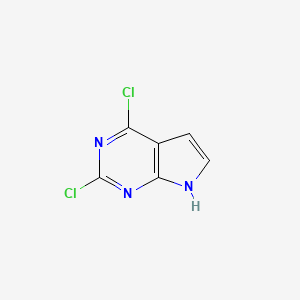
CAS · 90213-66-4
Product Overview
2,4-Dichloro-1H-pyrrolo2,3-dpyrimidine is a high-purity pharmaceutical-intermediates supplied for industrial and specialty chemical applications. Contact our team for specifications, packaging options and lead times.
Product Specifications
| Character | Off-white to pale yellow solid |
|---|---|
| Purity (HPLC) | 99% min |
| Dihydroxy impurity | 0.5% max |
| 2,6-Dichloropyrimidine | 0.1% max |
| Any single impurity | 0.15% max |
| Total impurities | 1% max |
| Assay (on dried basis) | 98% to 102% |
| Water | 0.5% max |
| Loss on drying | 0.5% max |
| Residue on ignition | 0.5% max |
| N,N-diisopropylethylamine | 0.2% max |
| Ethanol | 5000 ppm max |
| Ethyl acetate | 5000 ppm max |
| N-hexane | 290 ppm max |
| Toluene | 890 ppm max |
| Methanol | 3000 ppm max |
Applications
2,4-Dichloro-1H-pyrrolo[2,3-d]pyrimidine is widely used as a key intermediate in pharmaceutical and medicinal chemistry research. It serves as a versatile building block for the synthesis of nucleoside analogues, kinase inhibitors, antiviral agents, and other bioactive heterocyclic compounds. The dichloro substitution enables selective nucleophilic substitution reactions, allowing chemists to introduce diverse functional groups at specific positions on the pyrrolopyrimidine core. This makes the compound valuable in structure–activity relationship (SAR) studies and drug discovery programs aimed at developing therapeutics targeting cancer, viral infections, and other diseases. It is also utilized in organic synthesis for constructing fused heterocyclic systems and as a reagent in advanced chemical transformations.
Benefits
The compound offers several advantages due to its rigid heterocyclic structure and reactive dichloro functionality. The chloro substituents provide high chemical reactivity for selective substitution, enabling efficient derivatization and molecular diversification. Its planar aromatic framework contributes to strong stacking interactions and potential binding affinity in biological systems, which is beneficial in drug design. The compound is chemically stable under standard storage and reaction conditions, ensuring reproducibility and reliability in synthetic workflows. Furthermore, it is compatible with a variety of solvents and reaction conditions, making it suitable for multi-step synthetic sequences in both laboratory and industrial research.
Conclusion
2,4-Dichloro-1H-pyrrolo[2,3-d]pyrimidine is a versatile and valuable intermediate in the development of nucleoside analogues, kinase inhibitors, and other biologically active compounds. Its applications in medicinal chemistry and heterocyclic synthesis, combined with benefits such as selective reactivity, chemical stability, and structural rigidity, make it an essential building block for modern drug discovery and advanced organic synthesis. The compound continues to support innovation in pharmaceutical research and the development of novel therapeutics.
Previous
4,4-dimethylcyclohexan-1-one丨CAS 4255-62-3
Next