
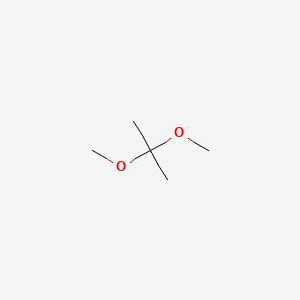
CAS · 77-76-9
Product Overview
2,2-Dimethoxypropane is a high-purity pesticide-intermediate supplied for industrial and specialty chemical applications. Contact our team for specifications, packaging options and lead times.
Product Specifications
| Appearance: | A Colorless Transparent Liquid |
|---|---|
| Content (G.C.): | 99.0% min |
| Moisture (K.F.): | 0.10% max |
Applications
1. Protecting Group in Organic Synthesis
2,2-Dimethoxypropane is primarily used in organic synthesis as a protecting group for alcohols. During chemical reactions where the alcohol group might react unwantedly, DMP is employed to temporarily protect the alcohol group. The protection is achieved by converting the alcohol into an ether form.
The protection group can later be removed by acidic hydrolysis or other deprotection methods, allowing for the subsequent manipulation of the molecule without affecting the alcohol.
2. Synthesis of Esters
DMP is used in the synthesis of esters, particularly in reactions where an esterification of alcohols and acids is required. The dimethoxypropane can act as a methylating agent in the formation of esters from alcohols and carboxylic acids.
It can also be used in the synthesis of esters from alcohols in the presence of acids, providing a high level of efficiency and yield. This makes it valuable in flavor and fragrance production, as well as in the pharmaceutical industry.
3. Synthesis of Cyclic Compounds
2,2-Dimethoxypropane is used in the synthesis of cyclic compounds such as tetrahydropyran derivatives. These compounds are important intermediates in the preparation of various bioactive molecules.
By reacting with alcohols and specific reagents, DMP can help form cyclic ethers that are often employed as intermediates in the production of complex organic compounds and pharmaceuticals.
4. Formation of Acetal Groups
2,2-Dimethoxypropane丨CAS 77-76-9 can be used to form acetals in carbohydrate chemistry. It reacts with carbonyl compounds, such as aldehydes or ketones, to form acetals or hemiketals. This process is often utilized in glycosylation reactions, where acetal formation protects the sugar unit.
This is particularly useful in the synthesis of glycosides and nucleosides, where the carbohydrate structure needs to be temporarily protected to allow other chemical transformations.
5. Use in Pharmaceutical Synthesis
The compound is also applied in the synthesis of pharmaceutical intermediates. By protecting alcohol groups or enabling esterification reactions, DMP facilitates the synthesis of complex drugs, especially those that require precise functional group manipulation.
It is used in the production of esters or cyclic ethers, which are often integral parts of drug molecules with specific bioactivity or pharmacological properties.
6. Polymer Chemistry
In polymer chemistry, 2,2-Dimethoxypropane is occasionally used to create crosslinking agents or co-polymers that require protection or controlled reactivity. The ether functionality provides a unique method for modifying polymer structures, enabling tailored material properties in the final products.
It is also utilized in creating protective coatings or adhesives where the functionality of the polymer needs to be controlled or activated by deprotecting the alcohol group later in the process.
Benefits
✅Efficient Protection of Alcohols
2,2-Dimethoxypropane丨CAS 77-76-9 provides an efficient method for protecting alcohols in complex organic syntheses, preventing unwanted reactions involving the alcohol group. It allows researchers to selectively perform reactions without interference from the alcohol's reactivity.
✅ High Yield in Ester Synthesis
As a methylating agent, DMP offers a highly effective way to synthesize esters, which are crucial in both flavor and fragrance industries, as well as in pharmaceuticals. The compound enhances the yield and purity of esterification reactions.
✅ Selective Reactivity
DMP's selective reactivity allows it to be used in a wide range of synthetic applications, from drug development to the synthesis of fine chemicals. Its ability to form acetals and cyclic compounds makes it an invaluable reagent in both academic research and industrial applications.
✅ Protection in Complex Reactions
By protecting alcohols as ethers, DMP enables chemists to carry out multi-step reactions without the risk of interfering with alcohol-based functional groups. This is especially important in complex synthetic pathways, where the precise manipulation of functional groups is essential.
✅ Ease of Removal
The protection group formed by DMP is easy to remove under mild acidic conditions, which is advantageous when the alcohol group needs to be re-exposed for further reactions. This reversible protection adds to its versatility and convenience in synthesis.
Conclusion
2,2-Dimethoxypropane丨CAS 77-76-9 is an essential reagent in organic chemistry with diverse applications in synthesis, particularly for protecting alcohol groups, synthesizing esters, and forming cyclic compounds. Its ability to protect alcohols and facilitate esterification reactions makes it a valuable tool in pharmaceutical synthesis, polymer chemistry, and biochemical research. Its ease of use, high yield, and selective reactivity add significant value in both laboratory and industrial applications, particularly when complex molecule synthesis requires precise manipulation of functional groups.
Previous
4,4-Dichlorodiphenyl Sulfone丨CAS 80-07-9
Next