
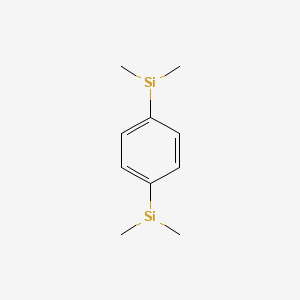
CAS · 2488-01-9
Product Overview
1,4-Bis(dimethylsilyl)benzene is a high-purity silicon-compounds supplied for industrial and specialty chemical applications. Contact our team for specifications, packaging options and lead times.
Product Specifications
| Appearance: | colorless transparent liquid |
|---|---|
| Purity(by GC): | 98% min |
| Moisture(%): | 0.1% max |
Applications
1,4-Bis(dimethylsilyl)benzene is a specialty organosilicon compound featuring both aromatic and silyl functionalities. It serves as a key intermediate, crosslinker, or monomer in several fields, including materials science, polymer chemistry, and electronics.
1. Precursor for Crosslinked Polysilanes and Siloxanes
The two reactive Si–H bonds allow this compound to undergo hydrosilylation, dehydrocoupling, or oxidative crosslinking:
Used to form siloxane or polysilane networks, especially in:
Silicone elastomers
Thermoset resins
Hybrid organic-inorganic materials
Because the dimethylsilyl groups are at para-positions, the resulting materials tend to have a linear or symmetrical architecture, contributing to uniform physical properties.
2. Building Block for Functional Polymers
1,4-Bis(dimethylsilyl)benzene is incorporated into high-performance polymers, such as:
Polysilanes with extended π-conjugation
Polysiloxanes for flexible and thermally stable materials
Silicon-containing block copolymers
These polymers are used in:
Dielectric materials
Optical coatings
Flexible electronics
3. Precursor in Hydrosilylation Chemistry
Each Si–H bond can react with unsaturated compounds (e.g., alkenes, alkynes, or vinyls) in hydrosilylation reactions, typically catalyzed by platinum or rhodium complexes. This enables:
Functionalization of polymer chains
End-capping or crosslinking of silicone polymers
Synthesis of tailored organosilicon molecules for surface modification or adhesion promoters
4. Intermediate in Synthesis of Aromatic-Silicon Hybrids
This compound is useful for introducing silicon centers directly onto aromatic cores, enabling:
Design of new hybrid materials combining organic and inorganic functionality
Improved thermal and oxidative stability
Enhanced mechanical properties for coatings and adhesives
These structures are attractive in microelectronics and aerospace-grade materials.
5. Use in Nanostructured and Porous Materials
When used in sol–gel or templated synthesis, 1,4-bis(dimethylsilyl)benzene acts as a bridging precursor for:
Organosilica frameworks (e.g., PMOs – periodic mesoporous organosilicas)
Porous hybrid materials for separation, catalysis, or sensing
The aromatic core contributes rigidity, while the silyl groups allow crosslinking or co-condensation with other silanes like TEOS or TMOS.
Benefits
1,4-Bis(dimethylsilyl)benzene offers a combination of structural versatility, reactivity, and performance-enhancing features that make it valuable across a range of advanced material applications.
1. Dual Silyl Reactivity
Contains two Si–H bonds, allowing for:
Symmetrical bifunctional crosslinking
Double hydrosilylation
Controlled network architecture
This makes it ideal for network polymer design, whether linear, star-shaped, or crosslinked.
2. Aromatic Rigidity with Silicon Flexibility
The benzene ring provides rigidity and stability
The dimethylsilyl groups provide reactivity and compatibility with flexible polymers
The balance of structural order and processability makes it suited for:
Functional coatings
Optical materials
Tough yet flexible elastomers
3. Thermally and Chemically Stable
Organosilicon materials based on this compound tend to exhibit:
High thermal resistance
Low flammability
Excellent weathering and UV resistance
These properties are crucial in high-performance electronics, automotive components, and aerospace materials.
4. Compatibility with Diverse Chemistries
Can be used in:
Platinum-catalyzed hydrosilylation
Radical-mediated processes
Dehydrogenative coupling
Compatible with a wide range of unsaturated or nucleophilic species
This broad compatibility allows fine-tuning of material properties and modular design of hybrid systems.
5. Useful in High-Purity and Low-Outgassing Applications
Organosilanes with defined aromatic cores like 1,4-bis(dimethylsilyl)benzene are often selected for:
Low volatility and low extractables
Stable dielectric and optical properties
Suitability for cleanroom or semiconductor-grade formulations
Conclusion
1,4-Bis(dimethylsilyl)benzene (CAS 2488-01-9) is a specialty bifunctional organosilane that serves as a key intermediate and crosslinker in advanced materials. Its unique combination of aromatic rigidity and silicon-based reactivity makes it essential in the development of:
Polysiloxanes and polysilanes
Crosslinked silicone networks
Hybrid inorganic-organic materials
Hydrosilylation-based modifications
Its utility in fields ranging from polymer science to electronics and aerospace underscores its value as a highly functional and adaptable building block.
Previous
1,1,5,5-Tetramethyl-3,3-diphenyltrisiloxane丨CAS 17875-55-7
Next